A practical guide by Greyhound Consilium, in partnership with Oracle
Greyhound Consilium is the B2B thought-leadership arm of The House Of Greyhound and a sister brand to Greyhound Research. It builds on Greyhound Research’s independent research through collaborations that produce thought-leadership content, research, and practical toolkits for decision-makers.
Guide In Two MinutesGuide synopsis · AI drafted · Analyst reviewed
Drafted by AI from the full guide and reviewed by a Greyhound Consilium analyst before publication. The advice and positions are Greyhound Consilium’s own.
Oracle introduced Fusion Claw on September 29, 2026, a governed runtime that lets Fusion’s agentic applications plan and carry out complex work within the authority a business delegates. Greyhound Consilium developed this guide in partnership with Oracle. It builds on the independent research report Greyhound Research published on October 14, 2026, and turns it into next steps for the CIO and the leaders who own each process in finance, HR, supply chain and sales.
The guide treats Fusion Claw as a dial, not a switch. Oracle’s three settings, human in the loop, human in the lead and autonomous execution, change how often a person steps in, never whether controls apply, because, in Oracle’s words, AI “can’t grant itself authority to act.” The authority sits in controls Fusion already holds: agent roles, tested policy models, approval points, the autonomy setting, budgets and exception routing. Greyhound Consilium’s advice is to set the dial outcome by outcome, start every new outcome at human in the loop, and move it up only as the receipts prove it, with an owner and a second signature for every decision.
Four process cards, for Ledger, Workforce Staffing, Shipping Consolidation and Account Territory Growth Plan, show where the dial starts in each function. A 90-day plan takes the first outcome from a name on a page to a higher setting, and the guide sets out what to measure, how to budget AI Units from your own test runs, who owns each decision, how to read receipts, and what regulators in seven jurisdictions ask. It carries six exhibits, thirteen tools and ten of Oracle’s published examples, and closes with four working sessions with your Oracle account team that turn it into a dated plan.
In This GuideSection guide · AI drafted · Analyst reviewed
Fourteen sections, each with a short summary. Select a title to go straight to that section.
Fusion Claw is a dial, not a switch. The business decides, outcome by outcome, how much authority to hand over, and Oracle’s guardrails apply at every setting. Before anyone opens the settings, settle the outcomes by name, the starting setting, the evidence that moves it up, and who decides.
Most of what a first run needs already exists in Fusion. Six preparations, covering authority, release, budget, data and region, assurance, and people, become fourteen items and two gates in a readiness map.
Choose the first process for the proof it gives: a number the CFO already watches and an executive ready to sign. Let Fusion Claw take the plan, and keep the final commitment with a person at first.
The envelope is set in controls Fusion already holds: roles, tested policy models, approval points and the autonomy setting, with budgets and exception routing keeping each run in hand. A short delegation record names who granted the authority, so every receipt can be checked against it.
Fifteen Claw-powered capabilities give every function more than one place to start. Four process cards, for Ledger, Workforce Staffing, Shipping Consolidation and Account Territory Growth Plan, show where the dial starts and the signal to move it.
Thirteen weeks take the first outcome from a name on a page to a higher setting on the dial, in five steps that follow Oracle’s own 90-day pattern for governing AI.
Business measures show the gain, and control measures show it was earned within the authority granted. AI Units per outcome, measured in your own test runs, set the budget.
Following Oracle’s three layers of ownership, every decision gets an owner and a second name. An action register and a receipt review make the program auditable, and the people whose work changes hear what is changing before the first test run.
Regulators in seven jurisdictions converge on a four-part rule, and Fusion Claw already provides much of it. A regulatory runway sets out each date and what to do, starting with the people questions.
Autonomy expands as receipts prove it: at least one new outcome a quarter, faster for similar ones, with every outcome running under Fusion’s own controls. A quarterly review loop decides what moves up, what holds and what comes next.
Four working sessions with your Oracle account team and implementation partner, all within the first month of the 90-day plan, turn this guide into a dated plan for your first outcome.
Thirty-seven sources in eight classes, from Oracle’s announcements, documentation and blogs to regulators’ texts, employee representatives and named buyers. Each entry carries its link, and every source is also linked where the text uses it.
Independence first, including that the guide was shared with Oracle for review before publication. The Financial Disclosure states that Oracle is a client of Greyhound Research. Intended Use sets out who the guide is for and that it is not legal or investment advice. Research method, authoring and copyright terms follow, including how Oracle and its partners may share the guide.
The Delegation Dial: Authority Granted In Advance, Outcome By Outcome
Every enterprise has work too complex for a simple rule and too frequent to do well by hand: closing the books, staffing a ward, consolidating inbound loads, redrawing sales territories. Teams take it to spreadsheets for hours, and the answer is often stale by the time it is ready.
Report In Two MinutesReport synopsis · AI drafted · Analyst reviewed
Drafted by AI from the full research report and reviewed by a Greyhound Research analyst before publication. The analysis and conclusions are Greyhound Research’s own.
On October 8, 2026, officials announced that the Department of Labor would stop processing pending permanent labor certification applications, known as PERM, and accept no new ones involving eight employers. They named Microsoft, Adobe, and six IT services firms. PERM is the first step in many employment-based green card cases. It is not the H-1B visa, and a PERM suspension does not, by itself, change anyone’s permission to work. As of October 20, 2026, Greyhound Research could not locate the written terms in public channels: a notice, the legal authority relied on, the legal entities covered, or a start date. Notices sent directly to employers would not necessarily appear there. Greyhound Research sets the officials’ words beside the regulation that fits them, the Department’s own case files, and the companies’ statements.
The regulation that best fits the announcement, 20 CFR 656.31, allows processing to be suspended while investigations run, and a suspension is not a finding. Its text, on Greyhound Research’s reading, speaks least directly to refusing new filings, though the Department may rely on an authority it has not yet stated publicly. On Greyhound Research’s count of the Department’s files, the six services firms received 116 PERM certifications in the nine months to June 2026, fewer than Adobe’s 182. Microsoft received 1,600 of the eight’s 1,898, or 84 percent. Of the ten figures officials reportedly cited, three are consistent with public counts, one sits close to a related measure, two are not found in the public record, and four are not tested on it. The government may hold records that are not public, such as investigation files and pending cases.
For CIOs, exposure runs through named people in named services, not brands, and nothing in the officials’ statements, as reported, indicates a product risk for software subscriptions. Suppliers, named or not, face a test of whether their PERM pipelines and their recruitment and pay records would stand scrutiny. Greyhound Research credits enforcement on the programs’ own terms, because it shows buyers whose recruitment and pay records stand up. It treats neither the administration’s public counts nor the companies’ statements as proof of whether any named company replaced US workers. For buyers, the decision rule has four steps: map the business dependency, verify the sponsoring legal entity, obtain the supplier’s case counts by stage for each dependent service, and fund a proportionate continuity response. The full research report carries four exhibits, 22 tables, buyer and supplier playbooks, and 13 questions open on the public record as of October 20, 2026.
In This Research ReportSection guide · AI drafted · Analyst reviewed
Fifteen sections, each with a short summary. Select a title to go straight to that section.
On October 8, officials announced that the Department of Labor would neither process pending PERM cases nor accept new ones involving eight employers. Greyhound Research reads the action as a pause while investigations run, not a finding. As of October 20, 2026, Greyhound Research could not locate the written terms in public channels.
A labor certification belongs to a specific employer and job, so Greyhound Research maps exposure by sponsoring entity and immigration stage, not by brand. Which entities each suspension covers, and when its initial 180 days began, depend on written terms not public as of October 20, 2026.
The H-1B program rests on an employer’s attested word on pay and conditions, while PERM tests whether US workers are available for the job. As announced, only PERM has stopped at the eight, so no H-1B total sizes a supplier’s exposure.
Officials’ figures and company statements are graded against the public record, and each grade describes that record, not records the government may hold. Of the ten figures officials reportedly cited, three are consistent with public counts, one sits close to a related measure, two are not found in the public record, and four are not tested on it.
Among decided cases, the Department’s files show that the six services firms, and Amazon, Google, Meta, and Apple, had largely left PERM by fiscal 2026, while Microsoft had not. Named and unnamed employers sit side by side on each measure tested, so the public files cannot explain why these eight were named. That leaves the officials’ stated basis, alleged fraud and, for Adobe and Microsoft, active federal investigations, as the explanation on the record.
A buyer’s exposure is set by the sponsored people inside its accounts, not by the brands on the list. The section maps sourcing models, the contract levers, who carries the cost of a stalled case, and what a buyer may and may not ask.
The eight share one suspension but not one exposure. On decided cases since fiscal 2025, the largest certification counts are Microsoft’s and then Adobe’s, and the evidence of whether each pipeline would stand scrutiny sits in each supplier’s own records.
Officials tied the list to alleged fraud and, for Adobe and Microsoft, active federal investigations, and Greyhound Research reads the list as silent on every sponsor it leaves out. Settlements, closed wage cases, and audits show that the same recruitment, layoff, and wage questions can reach any sponsor, named or not.
The deadlines inside each worker’s case keep running while processing stands still. Four clocks sit inside the green card case and four in the worker’s status, and three of them can end a case or a stay outright.
A buyer playbook and a supplier playbook, each of eight steps with an owner and evidence that the step was done. Review points from 30 days to 36 months open on evidence, not on elapsed time.
Thirteen questions remain open on the public record as of October 20, 2026, for the Department of Labor, the White House, the named employers, and their peers. Two matter most: the authority cited for refusing new filings and the legal entities each suspension covers.
The suspensions are a delivery problem for buyers, located in named people, and a pipeline test for suppliers. Greyhound Research credits enforcement on the programs’ own terms and sets out what would move its judgment either way.
The record behind the analysis: the supplementary H-1B counts, every legal and immigration point with its official text and practitioner verification, the method and its limits, and the terms used.
Five classes of public sources, 183 in all, begin with official records, company statements and filings, and academic research. Reporting, practitioner interpretation, and organizations’ statements form the fourth class, and prior Greyhound Research analysis the fifth. Each entry carries its link, and every source named in the text is linked where it appears.
Independence first, including that no named organization was offered a pre-publication factual review. The Financial Disclosure states that no organization commissioned, sponsored, or funded the report, including Infosys and Oracle, both clients of Greyhound Research. Intended Use sets out who the report is for and that it is not legal or investment advice. Research method, authoring, and copyright terms follow.
What Changed: The October 8 Suspensions As Announced
At a White House press conference on visa fraud on October 8, 2026, Vice President JD Vance said the government was suspending Microsoft from the program through which employers sponsor foreign workers for permanent residence. He cited alleged fraud. Secretary of Labor Keith Sonderling said the suspension would also cover Adobe and six IT services firms: Cognizant, Infosys, Tata Consultancy Services, Wipro, HCL Technologies (HCLTech), and Capgemini. “We will not accept any new or process any pending permanent labor certification applications involving these companies,” Sonderling said.
Report In Two MinutesReport synopsis · AI drafted · Analyst reviewed
Drafted by AI from the full research report and reviewed by a Greyhound Research analyst before publication. The analysis and conclusions are Greyhound Research’s own.
In July 2026 Microsoft reported that across its global operations in FY25 it replenished more water than it withdrew, 14.28 million cubic meters against 13.27 million. Greyhound Research tests that milestone, and the eleven community commitments Microsoft has made on water, electricity, and local economic return, against one standard applied twice. Does a facility take more than its place can spare, and does the benefit promised in return reach the people asked to accept it? Microsoft’s own foreword accepts the premise, saying that replenishing global volumes is not enough.
Microsoft’s own location table shows where the milestone landed. It lists 29 owned data center sites, about a third of the water the company reports withdrawing. Seven show a replenishment volume, eleven carry a promise dated FY30, and eleven have no plan disclosed. At Quincy, Washington, the largest draw in the table, 1,292 megaliters withdrawn sits against 833 replenished. The milestone sits outside the accountant’s review, and the reviewed withdrawal figure rose 14.5 percent in the same year. On electricity, the renewable record is real and well built, but annual matching cannot show that a local grid had power in the hour a site needed it, and no ratepayer can yet test the price pledge. About 8,550 megaliters of withdrawal sits outside the site table, in leased data centers, offices, and smaller sites, and the economic commitments arrive without baselines. Greyhound Research credits the dated promises, the end of non-disclosure agreements with local governments, and the four sites where replenishment exceeds local withdrawal.
For technology leaders, the consequence runs through specific dependencies, not headlines. Establish which regions and availability zones run on capacity outside Microsoft’s site table before the next renewal, tie capacity plans to utility and approval milestones, and test whether a fallback shares the same grid or water supply. The research report sets out the evidence in ten exhibits and nine tables, the Greyhound CXO Runbook, and the ten questions only Microsoft can answer, most of them for a column or a figure it already holds.
In This Research ReportSection guide · AI drafted · Analyst reviewed
Thirteen sections, each with a short summary. Select a title to go straight to that section.
Every commitment to a community is judged twice: does a facility take more than its place can spare, and does the promised benefit reach the people asked to accept it? Greyhound Research applies the same test to itself.
Eleven commitments from five Microsoft sources, on water, electricity, and local economic return, are now precise enough to test. Exhibit 3 places all eleven on one page, and the pattern repeats: reporting is company-wide, while the promises were local.
Microsoft’s location table covers 29 owned sites and about a third of its reported withdrawals. Seven show replenishment, eleven carry FY30 promises, and eleven show no plan. The global milestone sits outside the accountant’s review.
A local water account needs volumes with local context, benefits dated to the season they arrive, and cooling choices weighed against water and electricity together. The cheapest step, a cooling-type column, is already in Microsoft’s hands.
Microsoft took the harder route to the 100 percent renewable matching it reports for FY25, with about 93 percent from contracts and on-site generation. Annual matching still cannot show hourly local supply, and no ratepayer can yet test the price pledge.
A consultation lasts months, and a data center is expected to run for twenty or thirty years. The record of what was promised needs a stable facility identifier, reporting on an agreed schedule, and a named response when a commitment is missed.
About 8,550 megaliters of Microsoft’s reported withdrawal sits outside the location table, in leased data centers, offices, and smaller sites, with the split unpublished. Greyhound Research holds that a commitment travels with the capacity, whoever operates the building.
Microsoft names amounts, places, and headcounts, and gave up a local incentive at Mount Pleasant, Wisconsin. Without baselines, no one can yet tell what a community gained beyond what it would have received anyway, or which jobs outlast construction.
Five actions for technology, procurement, and risk teams, each with an owner and a moment in the buying cycle. A disclosure gap is not an outage, and the right response depends on which of four kinds of evidence is in hand.
Ten questions only Microsoft can answer, in the order the evidence raises them. Most ask for a column, a scope note, or a figure the company already holds, and two would change what this report can conclude.
The global promise is kept, and the local one is still owed. Greyhound Research credits the dated promises and the openness commitment, and asks for two disclosures: the leased estate in the location table, and delivered volumes at the promised sites.
Forty-two sources in seven classes, from Microsoft’s own disclosures to regulators, scientific references, and independent reporting. Each entry gives the exact title, the date, and a live link, and every source named in the text is linked where it appears.
Independence first, including that this edition was not submitted to Microsoft for factual review. The Financial Disclosure confirms that no organization commissioned or paid for the report and that neither Microsoft nor Amazon is a client, Intended Use sets out who the report is for and that it is not investment advice, and the research method, authoring and copyright terms follow.
In July, Microsoft said something it had never been able to say before. Across its global operations in FY25 it put back more water than it took out, 14.28 million cubic meters replenished against 13.27 million withdrawn. The ledger crossed. That is hard to do while building data centers at the pace the AI build-out demands. It rests on 98 funded projects across the company’s replenishment portfolio, and Microsoft is entitled to say so out loud.
Report In Two MinutesReport synopsis · AI drafted · Analyst reviewed
Drafted by AI from the full research report and reviewed by a Greyhound Research analyst before publication. The analysis and conclusions are Greyhound Research’s own.
On September 29, 2026 Oracle announced Fusion Claw, a governed runtime that lets its Fusion agentic applications plan and execute work on their own inside the system of record, under authority the customer delegates. Oracle frames it around three constructs: an Enterprise Operating Envelope for the boundaries, an Outcome Trust Harness for each run, and an Outcome Receipt for the record. Greyhound Research tested the announcement against the four verbs it set out in July: name the identity, read the log, bound the authority, and reverse the action.
The documented record is real and dated: a per-application switch in Release 26D, fifteen named capabilities, a Fusion Claw row in Oracle’s contract that meters planning on frontier models, budgets with auto-stop, and a sentence stating that the AI cannot grant itself authority to act. Oracle has also confirmed in writing that deterministic execution draws no AI Units, that outcomes run asynchronously with no 60-second limit, that reasoning runs where the model provider offers the model, and that Fusion Claw depends on no OpenClaw component. The runtime itself, the receipt’s export and retention terms, units per outcome and a named customer are not yet documented. Greyhound Research judges bound the authority documented and strengthened, read the log the richest per-run record seen from a system-of-record vendor but conditional on a specification, name the identity bounded by the running user’s access, and reverse the action left with the system of record, as it is across the category.
For technology leaders the work is procedural before it is strategic. Set the boundaries in the roles, approvals and policies Fusion already holds, put the region of reasoning in writing, classify each outcome by whether it can be reversed, read one receipt against the audit tables in research mode, and measure units per outcome before the budget is set. The research report sets out the evidence, the Greyhound CXO Runbook, and the ten questions only Oracle can settle.
In This Research ReportSection guide · AI drafted · Analyst reviewed
Seventeen sections, each with a short summary. Select a title to go straight to that section.
Oracle launched Fusion Claw on September 29, a runtime that lets Fusion’s agentic applications plan and complete work under authority the customer delegates. The four tests Greyhound Research set in July are the measure it faces, and the terms are explained in plain words.
Claw is aimed at data-heavy, constraint-rich work such as rostering and freight consolidation. The customer chooses one of three autonomy levels, and the authority comes from roles, approvals and policies Fusion already holds.
Three Oracle documents name Fusion Claw: a per-application switch, fifteen named capabilities and a metered row in the contract. Availability follows Release 26D cohort by cohort, and no customer is named yet.
Oracle describes a container per outcome in which the planning model never touches the ledger. The design is the right one, but no Oracle document describes it yet, so buyers should treat it as a vendor statement.
Bound the authority is documented and strengthened, read the log is rich but unspecified, and name the identity is borrowed from the running user. The receipt does not yet name the policy or the person who delegated it.
Nothing in the Claw constructs unwinds a posted outcome. Reversal stays with Fusion’s own compensating transactions, as it does across the category, and the documented stop halts the whole fleet rather than one outcome.
Every Claw outcome plans on a frontier model that runs where its provider offers it, which for Mumbai, Singapore or Sydney means another continent. No control yet pins the reasoning to a region.
Regulators in seven jurisdictions converge on a four-part rule: answer for the agent, halt it, reconstruct what it did, and let a human change the result. The receipt meets the two parts about the record, not the two about intervention.
Oracle has confirmed in writing that Fusion Claw is its own architecture with no OpenClaw dependency. An equipment maker holds a live trademark application for the same name, so contracts should name the capability by function.
Buyers ask who answers for an autonomous outcome before they ask what it can do. Finance and HR are cautious, operations is further along, and buyers are ahead of vendors on agent identity.
Oracle’s contract changed on announcement day and meters a Claw action at 20x on a Frontier model. The design is sound for cost, but units per outcome, the number a budget needs, is unpublished.
The controls are documented, the runtime is claimed, and eight items are owed. The right response is staged trust: research mode first, then full auto one outcome class at a time.
Five actions, each with an owner: set the envelope and the unit cap, put the region of reasoning in writing, sort outcomes by whether they can be reversed, read a receipt against the audit tables, and measure units per outcome.
Ten questions only Oracle can answer, from the 25 applications by name to the receipt specification, a cancel for a single outcome and units per outcome. Greyhound Research will publish the answers as given.
Fusion Claw is new machinery, not new vocabulary, and confidence rose on two verbs and held on two. Oracle has built the part that obeys. The part that delegates is the buyer’s, set in controls Fusion already holds.
What Oracle Launched: A Runtime That Acts On Delegated Authority
On September 29, 2026 Oracle announced Oracle Fusion Claw, which its release describes as “a governed agentic execution runtime for Oracle Fusion Agentic Applications that combines AI reasoning with deterministic enterprise computation to enable highly complex work to be economically completed at scale.” Three constructs govern it in Oracle’s account: an Enterprise Operating Envelope, an Outcome Trust Harness, and an Outcome Receipt. For a technology leader the announcement describes something more specific than a runtime. It describes software that will act on its own inside the system of record, under an authority the buyer has to write down first.
Research Note In Two MinutesAI drafted · Analyst reviewed
Drafted by AI from the full research note and reviewed by a Greyhound Research analyst before publication. The analysis and conclusions are Greyhound Research’s own.
On August 31, 2026 the boards of ITC Infotech and Happiest Minds Technologies approved a combination of two of India’s mid-tier technology services firms. The transaction is announced and board-approved, not completed. Approvals are still to come, the companies operate independently until they arrive, and the window runs to roughly fifteen months.
Read as capability, this is two written-down gaps closing at once, a product engineering and generative AI gap at ITC Infotech and an enterprise applications gap at Happiest Minds. Each side is buying the half of the stack it could not build in time.
Happiest Minds earns about 80 percent of its revenue from product and digital engineering and brings its own platforms, Arttha among them. ITC Infotech brings the run side, more than 2,700 SAP consultants, more than 700 PLM professionals, and a managed services franchise weighted toward Europe. Together they carry more than 19,000 people and over 800 customers, against a stated ambition of USD 1 billion in revenue by FY28.
Greyhound Research’s position is that the consequential change is not the transaction but the redrawing of the middle of the Indian IT services market, where most enterprise buyers hold their leverage. The capability case is real on both sides. The risk sits in the integration seams, which surface in delivery rather than in announcements.
Four seams decide the outcome. Two agent platforms have to become one. Two security operations centers and two AIOps estates have to converge. The AI-first claim has to survive a customer’s governance review. And the engineers who make Happiest Minds distinctive have to stay.
For a technology leader with either firm on the vendor list, the supplier has changed shape and last year’s account plan no longer describes it. Greyhound Research recommends three asks, this quarter rather than next year: the integration plan in writing rather than the synergy narrative, who will run the combined engineering estate, and continuity commitments on the roles that hold the seams together. The research note sets out which management claims a buyer can verify and which they cannot, along with the triggers that would change this position.
On August 31, 2026 the boards of ITC Infotech and Happiest Minds Technologies approved a combination that the transaction materials describe in arithmetic: more than 19,000 people, over 800 customers, and a stated ambition of USD 1 billion in revenue by FY28. It is also the second business ITC has moved toward a public market in nineteen months, after the ITC Hotels demerger of January 2025 and on close to identical stated reasoning, which makes this listing a question of when and not whether. For a technology leader the same announcement describes something more specific.
On July 14, Oracle announced an AI-native builder experience for Oracle AI Agent Studio for Fusion Applications, spanning no-code, low-code, and pro-code development at what Oracle states is no additional cost to Fusion customers. Per Oracle, the experience would enable customers and partners to create and run Fusion Agentic Applications, a class of outcome-driven applications executed by coordinated teams of specialized AI agents, natively inside Oracle Fusion Cloud Applications.
Greyhound Research sorts this announcement against what Oracle AI Agent Studio for Fusion Applications already offers, and the sort yields four grades: the new, the extended, the expanded, and the established.
New: the AI Studio Skill. Per the release, the Skill anchors the pro-code path, bringing Visual Studio Code, Git-based command-line workflows, and AI coding assistants including Codex and Claude Code into Fusion-native development. A skill packages the platform knowledge that guides coding assistants.
In Greyhound Research’s view, Oracle’s intent is to bring agentic development closer to a conventional software lifecycle, with local validation and pipeline-based release replacing configurations trapped in an administration console; whether the resulting artifacts prove portable, reversible, and consistently governed across both build paths remains to be demonstrated.
Extended: the ecosystem, via GitHub. A promised public GitHub repository is slated to carry templates, starter projects, and reference architectures, together with sample applications and reusable assets, giving partners and developers a common starting point that Oracle’s studio tooling has not offered before.
Our read of the intent: Oracle is seeding a developer ecosystem around Fusion rather than a studio alone, because public code is how a platform recruits builders; the seriousness of that ambition will be measured by whether the repository arrives live, populated, and actively maintained over time.
Expanded: a marketplace of applications. The AI Agent Marketplace is set to grow from a catalog of individual agents to one of complete agentic applications, sitting alongside the existing portfolio of Oracle, partner, and third-party agents customers can already deploy inside Fusion.
Greyhound Research reads the intent as distribution at scale, turning partner-built applications into catalog products rather than one-off implementations; an application that installs from a catalog and runs as a governed Fusion artifact can travel through Oracle’s channel and partner network in a way bespoke builds never could.
Established: the studio and portfolio. Oracle AI Agent Studio launched in 2025; the natural-language and low-code builders, the approval workflows, and the interoperability protocols are documented capabilities, as are testing and observability, while Oracle’s own counts put the current portfolio at 22 Fusion Agentic Applications, 1,000-plus embedded agents, and 80,000 certified experts trained in the studio.
The intent, as we read it, is continuity: this release does not introduce its agentic direction; it attempts to turn that direction into a broader development and distribution model, built on capabilities Oracle already ships. The centre of gravity shifts from building or customising agents to building and running governed applications natively inside Fusion.
Table 1 grades the announcement in one view.
Greyhound Standpoint: At Greyhound Research, we believe the significance of this announcement is not more agents; the market is already saturated with those. The enterprise agent race has quietly changed shape, and the contest is no longer over who builds the smartest agent but over who owns the governed runtime in which agents are permitted to act. Oracle’s architectural claim is that agents born inside the system of record inherit the security, approvals, and auditability that agents built outside it must reconstruct at great expense.
Why This Matters To CIOs
Greyhound Fieldnotes, drawn from Greyhound Research’s advisory work, confirm that the problem Oracle is aiming at is the real one. Across our 2026 advisory work, we have repeatedly found that the hardest problem in enterprise AI is not building an agent; it is operating one. When agents are built outside the enterprise system, the organization must separately solve identity, approvals, and audits, along with the observability and lifecycle plumbing beneath them, and that is precisely where pilots stall.
Greyhound Research believes Oracle’s claim is credible because it attacks the hardest problem in enterprise AI. On detail, spanning identity semantics, logging depth, and reversibility, it remains unproven. Whether it holds will be decided by the technical documentation Oracle publishes, not by the announcement.
Greyhound Fieldnotes record a consistent pattern: the demonstration wins the room, and the deployment then dies in the corridor between the innovation team and the controller’s office. The agent may perform the task, but production stalls because machine actors were never provisioned within the identity model, the approval matrix, or the audit trail. That corridor is the difference between real governance and dashboard governance.
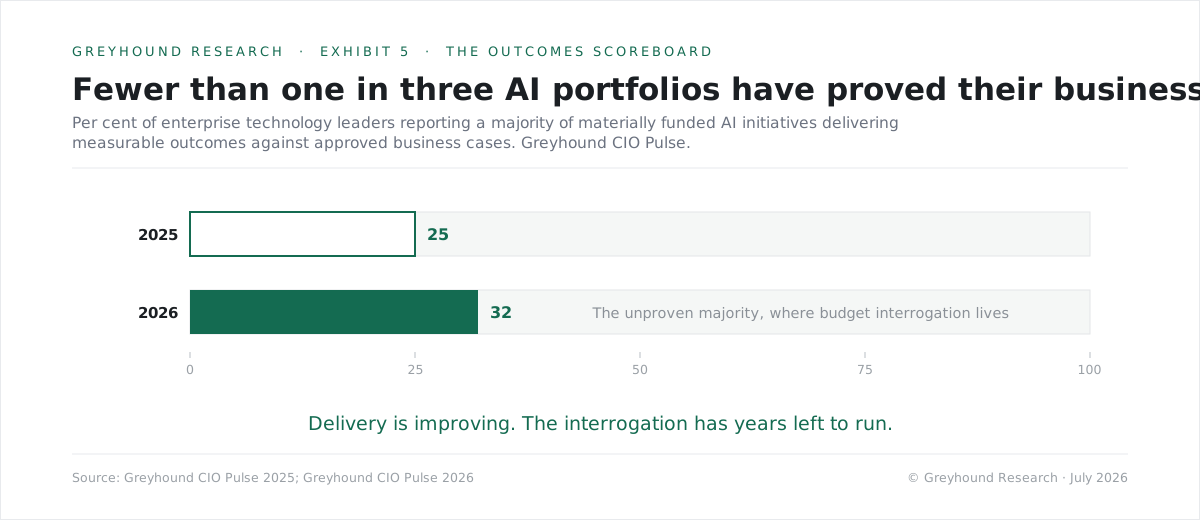
Greyhound CIO Pulse 2026, across more than 1,000 technology leaders, finds fewer than one in three can point to measurable outcomes across most of their funded AI portfolio. Adoption is not value. Pilots are not production. In agentic systems, the distance between the two is filled by identity, controls, auditability, and the uncomfortable question of who remains accountable when software begins to act.
Every major vendor is racing to own the answer, each positioning from its own center of gravity. Microsoft is building outward from productivity and the Power Platform, with an administrative control plane spanning its estate. Salesforce is anchoring on customer data, wrapping agent actions in its trust layer and CRM context. ServiceNow is treating the workflow itself as the governing structure, extending its control-tower discipline to agents. SAP is grounding agents in harmonized processes and business-data context across its suite, while Workday is positioning the agent as a governed object inside its system of record for people and money. Beyond the suites sit two further archetypes: independent orchestration platforms, which offer breadth across models and tools yet must reconstruct enterprise controls from the outside, and automation-led alternatives, which execute reliably within scripted boundaries and reason poorly beyond them.
Greyhound Standpoint: At Greyhound Research, we believe Oracle is making the same bet as its rivals, just deeper. Oracle is betting on the depth of Fusion-native business objects, transactional workflows, and inherited application controls as the foundation for agentic execution; the argument is that the control plane belongs inside the application runtime because that is where the approval chains and audit trails already live. If that claim holds, the payoff is practical: a company can move from AI that recommends an action to AI that takes the action itself, under the controls it already trusts, without first building the governance plumbing from scratch.
What Oracle Must Still Prove
Greyhound Research’s position is that five questions decide whether the governance claim survives contact with a real-world customer deployment.
Identity. Does each agent operate as a distinct principal under least privilege, or does it borrow the entitlements of a human user?
The record. What is logged, from prompts and tool calls to the model version behind each action, and can the customer export it?
Reversibility. A bad chain of actions must be unwound through compensating transactions once it has executed; what mechanism exists, and who triggers it?
Model governance. Oracle documents customer choice across its own curated models and external ones, which makes substitution a routine event; a swap beneath a live application needs to be approved, traced, and benchmarked.
Third-party participation. How are external agents arriving over the MCP and A2A interoperability protocols authenticated, sandboxed, and revoked?
The marketplace adds a sixth question. Oracle publishes a 21-point enterprise readiness checklist for partner-built agents, an unusually concrete disclosure by the standards of this market, yet the harder questions begin after inspection: who carries liability when a partner-built application misfires inside a customer’s ledger, how updates are controlled once that application is live, and what commercial terms bind Oracle, the partner, and the customer when something breaks.
Lest we forget, certification is a gate and accountability is a contract.
A Word Of Caution For CIOs
Greyhound Research cautions that a native runtime relocates complexity; it does not cancel it. What such a runtime genuinely removes is the bolt-on burden: security, approvals, and audits can be reused rather than rebuilt around the agent because the application platform already carries them. What remains moves to harder ground, domain by domain, and our work with buying organizations shows the year-one bill takes a different shape in every estate, with none of the shapes zero.
Employee services run light; employment decisions run heavy. Bounded services such as policy guidance and scheduling carry the lightest lift, because authority stays narrow and approvals explicit. Employment, compensation, and promotion decisions sit at the other end, touching identifiable human beings and converting software defects into legal and reputational events; they fall in the EU AI Act’s high-risk category for employment under Annex III, whose enforcement the newly adopted Digital Omnibus defers to December 2, 2027, while anti-discrimination and data protection laws bind them today. The map is wider than Brussels: the United States runs a patchwork of state, sectoral, and consumer-protection enforcement rather than one omnibus regime, and India’s Digital Personal Data Protection framework, its rules notified in November 2025, is moving through phased implementation to full enforcement by 13 May 2027, which puts personal-data duties on agentic deployments now, not at some future enforcement date.
Finance’s value comes with priced-in controls and audits. The heaviest controls burden sits here: the value in close acceleration and collections is real, and so is the cost of controls engineering, audit sign-off, and process redesign, because a controller will not accept a trace that cannot be walked. Reversibility matters most in this domain, since a single bad chain of postings must be unwound through compensating transactions, with a named owner for the trigger, before the auditors arrive.
Customer errors are intolerable but visible; pilot here. The bill arrives in integration and override design, since the tolerance for a wrong promise made to a paying customer is close to nil. The compensating advantage is visibility: unlike supply-chain errors, a customer-facing mistake surfaces immediately and hands to a human naturally, which is why service escalations sit among the very first sensible pilots, provided the override path is designed well before the agent ever speaks to a customer.
Stale records cap autonomy; cleanup comes before automation. Master data quality becomes the ceiling on autonomy, because an agent acting at machine speed compounds a single stale supplier record into a cascade of confident, well-logged mistakes, and the physical world reports them late. The first bill is therefore data remediation, and the sequencing follows from it: exception handling belongs strictly after the cleanup, not before, because autonomy built on stale records automates the error rather than the business process.
The riskiest failures hide at the cross-suite seams. Almost no enterprise is a single-suite estate, so real work crosses runtime boundaries as a matter of course, and at each crossing the agent’s identity, its authority and its audit trail change jurisdiction. Drift at those seams combines the highest impact with the lowest detectability of any failure mode in this category, and in the largest estates, partner fees, governance boards, and change management quickly overtake the software line itself.
Zero Oracle cost is not zero customer cost. Oracle states the capabilities arrive at no additional cost to Fusion customers, and the subscription genuinely bundles the studio. Oracle’s own marketplace documentation is explicit that agents deployed from partner-built templates count as custom AI and carry a separate subscription fee. The full year-one bill still arrives through implementation and controls engineering, partner and integrator fees, and infrastructure consumption at scale; the bundling decision therefore changes which budget carries the spend rather than eliminating the spend itself. The boundary between them is a contracting question, taken up in the engagement conversations below.
One caution outlasts the list: the AI Act deferral moves the enforcement date without moving the accountability. And one question spans every row above: whose control plane governs the agent whose task crosses three vendors’ runtimes? No vendor racing for this category has answered, and the buyer who asks first negotiates from strength.
How CIOs Should Engage Oracle: Six Conversations
Greyhound Research advises Fusion customers weighing Oracle AI Agent Studio and Fusion Agentic Applications to structure the Oracle engagement around six conversations, each of which can begin with the account team this quarter.
Scope the first Oracle pilot. Ask the account team to help stand up a use case that is bounded, measurable, and reversible, where governance inherits from day one. Collections and service escalations meet those tests today; hold the financial close to advisory or exception-led mode until transaction traceability and compensating controls are demonstrated, and let supply chain exception handling wait for clean master data. A pilot chosen on these criteria produces evidence; a pilot chosen on enthusiasm produces a demo.
Put five questions in writing. Ask the account manager for written answers to the questions this note itemizes: whether each agent operates as a distinct principal under least privilege or borrows a human’s entitlements; what is logged, from prompts and tool calls to the model version behind each action, and whether you can export it; what compensating-transaction mechanism unwinds a bad chain of actions and who triggers it; how a model swap beneath a live application is approved, traced, and benchmarked; and how external agents arriving over MCP and A2A are authenticated, sandboxed, and revoked. Add the cross-suite question: Which control plane is the plane of record when an agent’s task crosses into your Salesforce, Workday, or ServiceNow estates. Any platform that asks to act inside your ledger owes the same answers, so the list travels to every suite vendor, including those yet to announce.
Demand AI Studio Skill specifics. If your developers will build rather than configure, ask for the Skill’s documentation, access to the promised repository, and a working demonstration before committing engineering time: how a Fusion Agentic Application is represented as an artifact under Git, how the same artifact behaves across the no-code and pro-code paths, and how local validation and pipeline-based release interact with Fusion’s runtime governance. The documentation should also show versioning, rollback semantics, agent identity boundaries, approval threshold configuration, transaction integrity across multi-step actions, and reasoning trace access. Whether those artifacts prove portable, reversible, and consistently governed is the announcement’s central open question; have Oracle answer it in your environment, not in a keynote.
Define what the bundle covers. The subscription bundles the studio; the year-one bill still arrives through implementation and controls engineering, partner and integrator fees, and infrastructure consumption at scale. Ask which of the 22 Fusion Agentic Applications and the 1,000-plus embedded agents your existing subscription already includes, which arrive with partner commercials attached, and which budget carries each line, in writing, before deployment rather than after.
Settle partner-application liability before installing. The marketplace questions raised above become a contracting conversation here: before installing a partner-built application, get written answers on who carries liability when it misfires inside your ledger, how its updates are controlled once live, and which commercial terms bind Oracle, the partner, and you when something breaks. Inspection is Oracle’s gate; the accountability contract is yours to negotiate, and it is negotiated before installation, not at the incident review.
Negotiate the exit before entry. Native governance is real, and it is also non-portable. Every agentic application built as a Fusion runtime artifact deepens platform gravity, so a buyer exchanging model-vendor optionality for application-platform dependency should arrive at the signature with exit clauses drafted and portability already tested. Ask the account team to demonstrate export: what leaves with you, in what format, and what remains behind.
None of these conversations require waiting for Oracle’s documentation, for a regulator, or for the market to settle. Each converts a buyer from a spectator of this contest into a participant who sets terms, and together they prepare an enterprise for the larger transition this announcement belongs to.
The Final Greyhound Research Standpoint
Greyhound Research holds that enterprise software is moving from recording work to executing it, and the transition will be won by the vendor that makes autonomy boringly governable. “Boring” is not a small word in this market; it is the highest compliment an enterprise system can earn, because “boring” means predictable, inspectable, and reversible, and those are the qualities a controller, an auditor, and a regulator will sign their names against.
The test is simple, and it travels well beyond Oracle.
Name the identity. Every agent runs as its own principal, holding the least privilege its task allows, never borrowing a human’s credentials.
Read the log. Every prompt, tool call, approval, and model version behind an action can be inspected and exported by the customer, not only by the vendor.
Bound the authority. Approval thresholds are set by the enterprise as policy on the transactions that matter and cannot be quietly widened.
Reverse the action. A bad chain of decisions can be unwound through compensating transactions, with a named owner for the trigger.
A buyer who cannot do these four things does not have an agentic application; it has an ungoverned employee with system access.
Oracle starts from a position of genuine strength. Against that test on day one, the public record is already strong where it matters first: agents acting on native business objects, under approval thresholds the enterprise sets. The remaining verbs, the full log, a distinct agent identity, and a demonstrated reversal remain open proof points: the public record neither establishes them nor establishes their absence, and the documentation will settle it. Across the leading vendors’ public material reviewed for this note, none yet documents all four in full, so the gap belongs to the category, not to Oracle. What it measures is how young this category still is and how much of its story will be written in documentation rather than announcements.
For Oracle, the path from here is concrete and entirely within its control: publish the technical documentation, bring the promised repository live, put named customers into production with measured outcomes, produce external audit artefacts, and give buyers the pricing and audit clarity they can carry into their own governance processes. Each of those steps converts the announcement’s promise into proof, and Oracle brings credible assets to the path: Fusion’s transactional depth, an established partner network, and its certified training base. Greyhound Research will track that evidence as it lands, and a full examination of the governed-runtime category will follow. Over three years, the market will split between platforms that can prove governed action inside systems of record and platforms that remain glorified orchestration layers.
Greyhound Standpoint: At Greyhound Research, we believe the prize in this market is accountable autonomy: agents that act under the controls an enterprise already trusts, with a named owner when they act wrongly. Oracle has moved the contest onto the ground where that prize is decided, and it has done so with the machinery of a runtime rather than the language of a demonstration. The evidence will now do the talking. Everything else is a demonstration.
Important Disclaimer
Greyhound Research are industry analysts, not equity analysts. This note is a demand-side assessment of Oracle’s announcement, architecture, and buyer implications; it is not investment advice, and nothing in it should be read as a view on securities. This note draws on pre-briefing materials provided under embargo by Oracle and on Greyhound Research’s own analysis; the announcement became public on July 14, 2026, and key figures were re-verified against public sources on July 19, 2026.
This is a strictly independent analysis: Oracle has not commissioned, paid for, reviewed, or influenced this note in any form, and Greyhound Research has received no compensation from Oracle or any other party for its production. The views expressed are Greyhound Research’s alone.
This note draws on Greyhound CIO Pulse 2026 and Greyhound Fieldnotes. Our full archive is available at greyhoundresearch.com.
Sources And References
Every load-bearing claim in this note traces to one of the sources below, presented in Harvard reference format and grouped by class. In-text author-date citations are deliberately omitted, as they serve academic writing rather than research intended for the executive desk. All sources accessed 19 July 2026.
Greyhound Research (2026a) Greyhound CIO Pulse 2026. Proprietary survey of more than 1,000 enterprise technology leaders.
Greyhound Research (2026b) Greyhound Fieldnotes. Advisory engagements with enterprise technology buyers, 2026.
Analyst In Focus: Sanchit Vir Gogia
Sanchit Vir Gogia, or SVG as he is popularly known, is a globally recognised technology analyst, innovation strategist, digital consultant and board advisor. SVG is the Chief Analyst, Founder & CEO of Greyhound Research, a Global, Award-Winning Technology Research, Advisory, Consulting & Education firm. Greyhound Research works closely with global organizations, their CxOs and the Board of Directors on Technology & Digital Transformation decisions. SVG is also the Founder & CEO of The House Of Greyhound, an eclectic venture focusing on interdisciplinary innovation.
Copyright Policy. All content contained on the Greyhound Research website is protected by copyright law and may not be reproduced, distributed, transmitted, displayed, published, or broadcast without the prior written permission of Greyhound Research or, in the case of third-party materials, the prior written consent of the copyright owner of that content. You may not alter, delete, obscure, or conceal any trademark, copyright, or other notice appearing in any Greyhound Research content. We request our readers not to copy Greyhound Research content and not republish or redistribute them (in whole or partially) via emails or republishing them in any media, including websites, newsletters, or intranets. We understand that you may want to share this content with others, so we’ve added tools under each content piece that allow you to share the content. If you have any questions, please get in touch with our Community Relations Team at connect@thofgr.com.
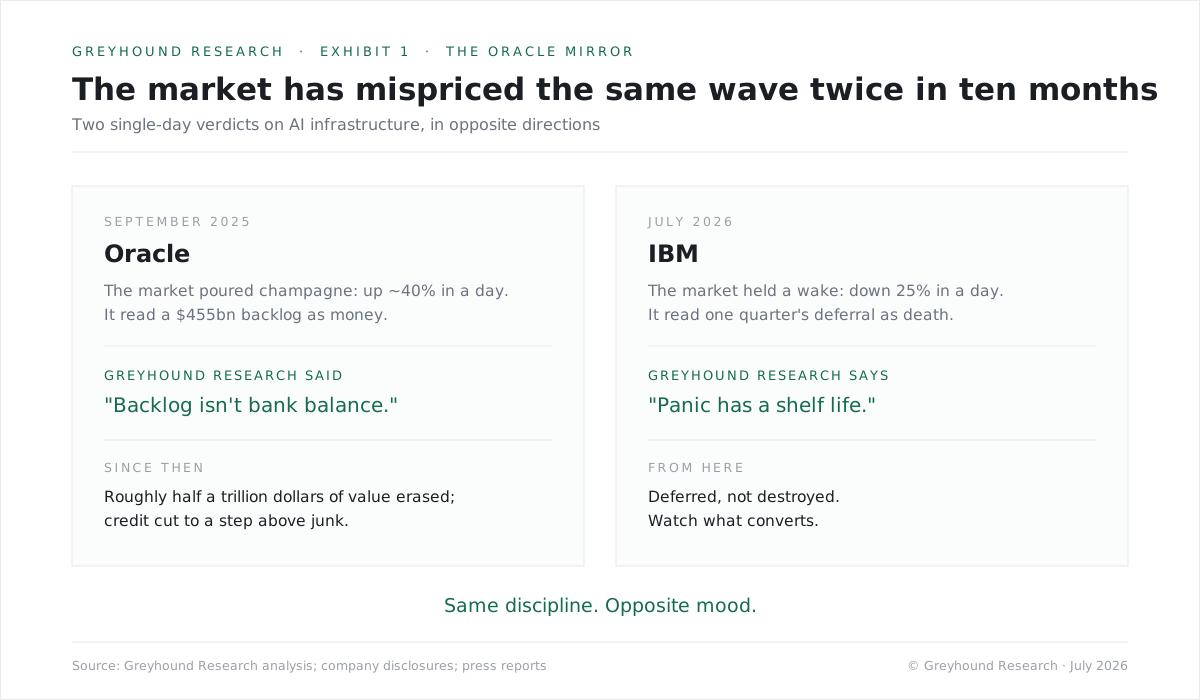
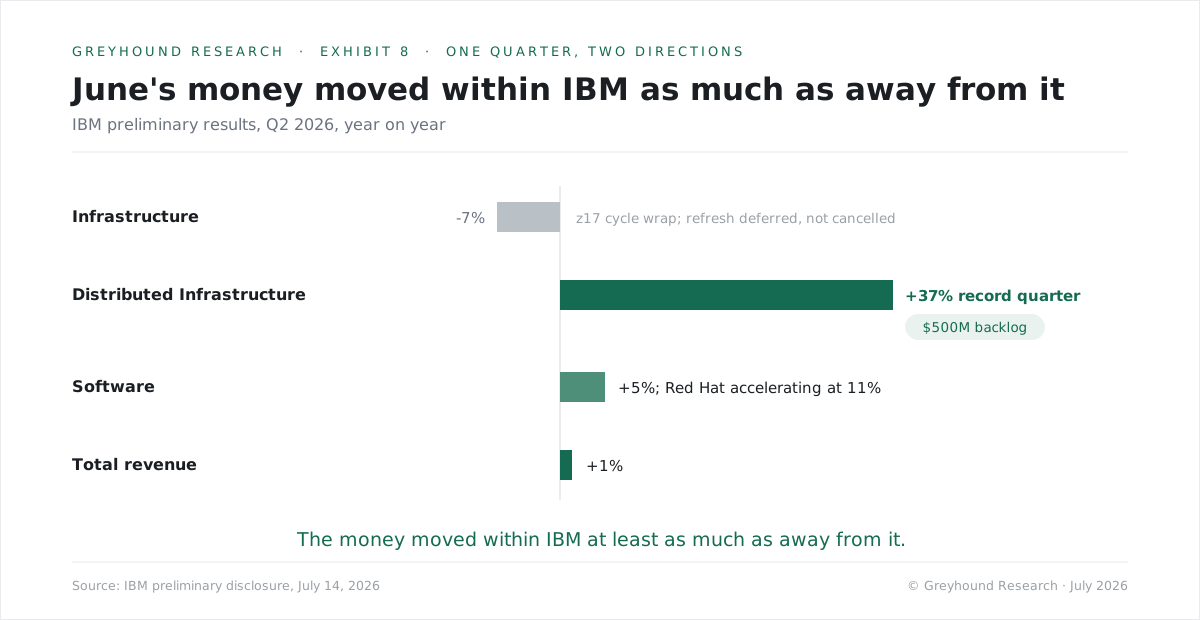
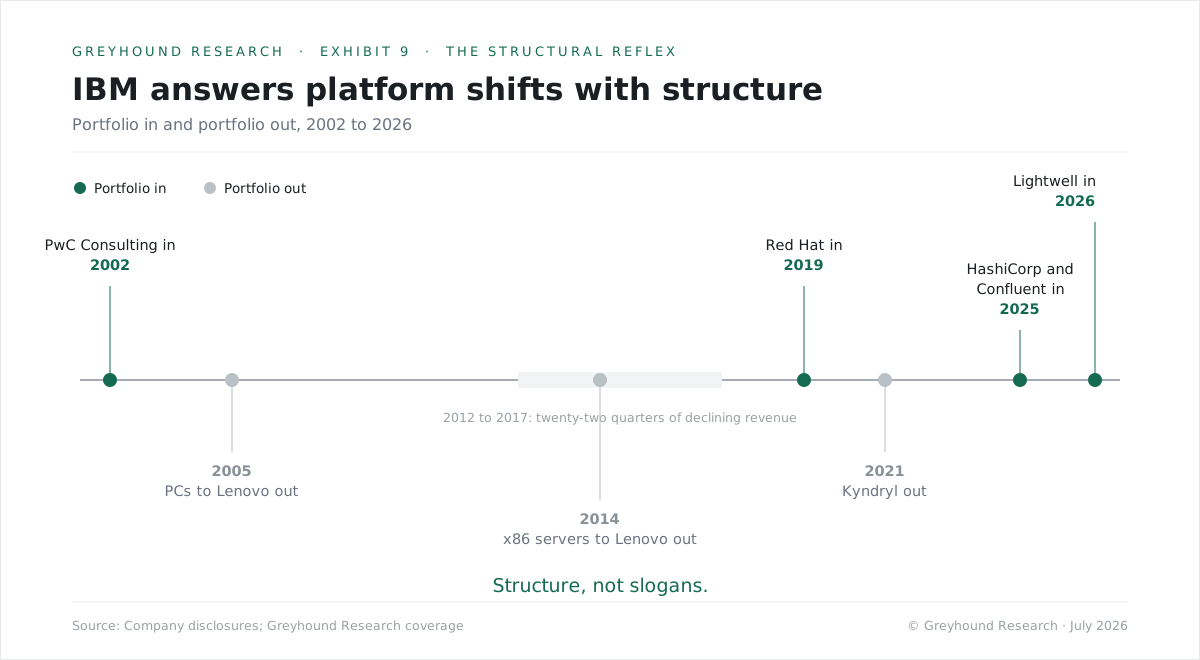
On July 14, IBM released preliminary second-quarter results a full week ahead of schedule. Revenue up 1 per cent. Software up 5 per cent. Infrastructure down 7 per cent as the strongest mainframe launch in the company’s history wrapped, and a candid admission that numerous large deals had slipped past the quarter boundary. For this, the market handed IBM the sharpest single-day fall in its modern record, erasing roughly a quarter of the company’s value, and within hours the commentary industry had declared that software was dying and IBM with it.
We have seen this film before, projected in reverse. In September 2025, Oracle announced a reported $300 billion compute contract with OpenAI, its shares had their sharpest day since 1992, and the market read a backlog as a bank balance. We wrote that week, in Backlog Isn’t Bank Balance, that theatre is not delivery, and that the applause was premature. Roughly half a trillion dollars of erased market value later, that caution needs no defending.
The market has now made the same mistake twice in ten months, in opposite directions: it priced Oracle’s applause as fact, and it is pricing IBM’s panic as fact. Euphoria, it has learned, has a shelf life. This note argues that panic has one too.
So before joining either the festival or the funeral, look at what actually moved, because there are quarters that reveal a company, and there are quarters that reveal its customers. This one revealed the customers. In the final weeks of June, technology buyers did something enterprise budgets are not supposed to do: they moved mid-quarter, at pace, redirecting capital into scarce hardware ahead of expected price increases. The behaviour was rational, defensive, and large enough to reorder vendor pipelines across the industry. IBM, standing directly in the path of that reflex, absorbed the visible damage and disclosed it early.
This note is not about the share price; that is not our trade, and it was not our trade in September either. It is about what the buyers did, why they did it, what IBM’s own disclosure actually says, and why the sum of that evidence leaves Greyhound Research more settled in its position on IBM’s franchise, not less. It draws on three bodies of evidence: IBM’s preliminary disclosure, published as Arvind Krishna’s letter to investors; the supply-side and buyer record around the event, including Greyhound CIO Pulse 2026; and our own published coverage, of IBM across more than a decade, and of this market’s moods across both of its recent extremes.
First, A Word On The Word Bullish
Greyhound Research are industry analysts, not equity analysts. We do not make share price calls, we do not publish targets, and we do not advise on positions. When we say we remain bullish on IBM, we mean bullish on the franchise: on the construction of its portfolio, on the durability of its demand, on the structural adaptability it has demonstrated across four decades of platform transitions, and on its relevance to the technology buyers we advise. Readers seeking an investment view should look elsewhere. Readers seeking a demand-side view, grounded in what enterprises actually do with their budgets, should read on.
What The Letter Says, And What The Tape Did
Strip away the noise and the preliminary print divides into three clean parts.
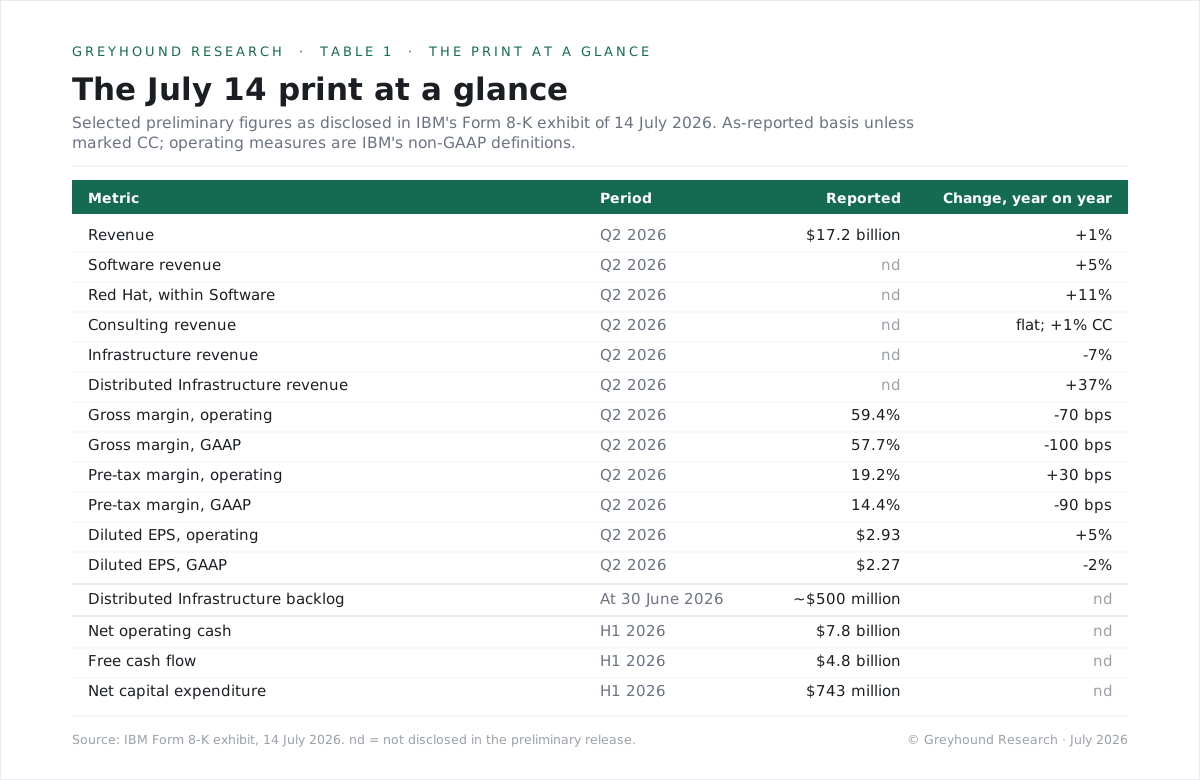
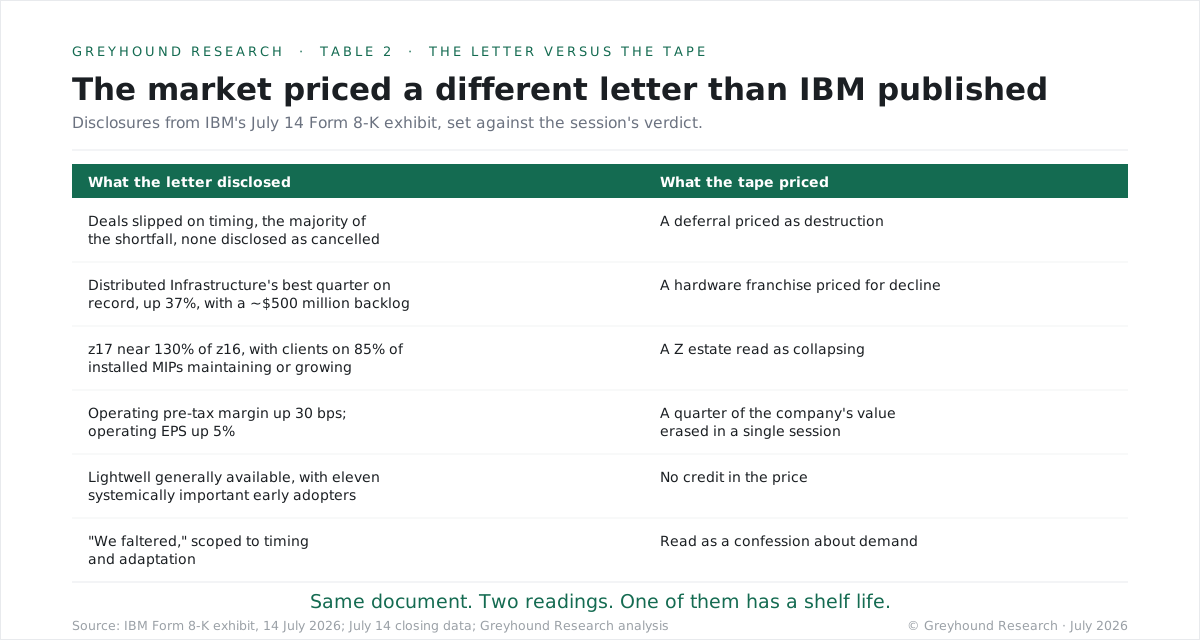
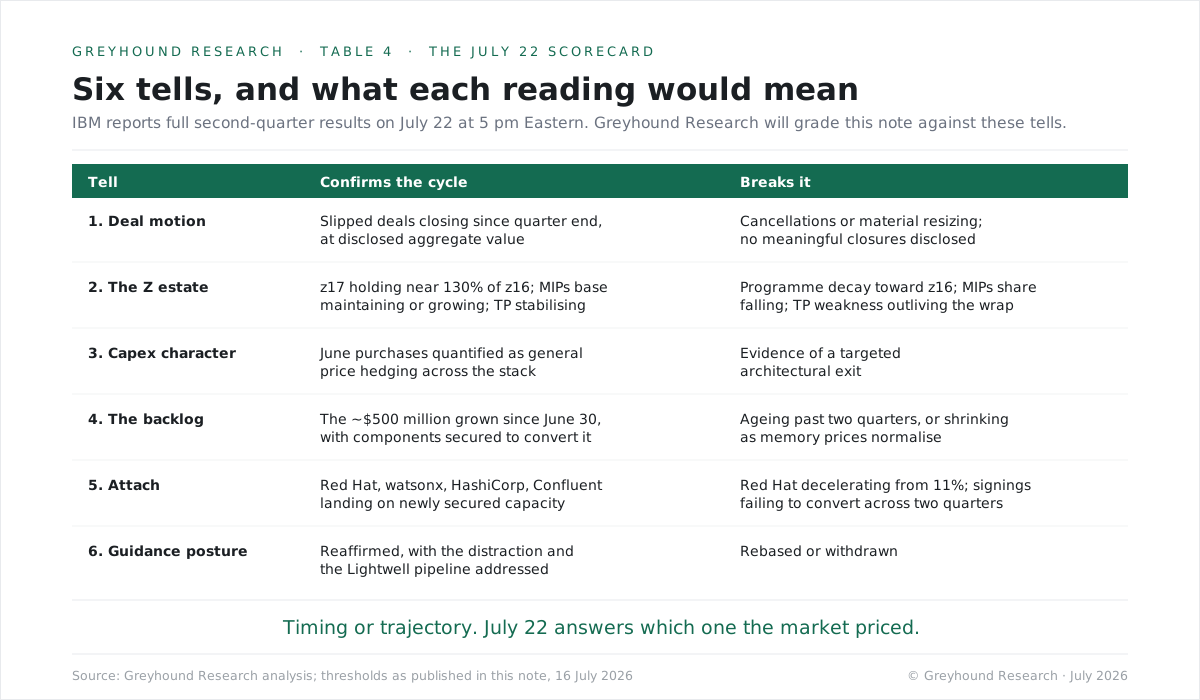
The first part is growth where the market claims there is none. Total revenue rose 1 per cent. Software rose 5 per cent, with Red Hat accelerating sequentially to 11 per cent growth and both HashiCorp and Confluent described as strong performers. Consulting revenue was flat, up 1 per cent at constant currency, while consulting signings continued to grow, led by GenAI engagements. Apply the same rule here that this note applies to backlog, because signings are not revenue either. Flat consulting revenue against growing signings is a conversion problem, and it is the one weakness in this print Greyhound Research will not attribute to June: we documented the friction in August 2025, in procurement cycles, in pricing and go-to-market alignment, and in delivery timelines running longer than buyers expected. Operating pre-tax margin expanded 30 basis points despite the shortfall, and operating earnings per share rose 5 per cent to $2.93 even as GAAP diluted earnings slipped 2 per cent to $2.27. These are not the vital signs of a broken model.
The second part is the miss, and it is unusually concentrated. Infrastructure revenue fell 7 per cent against IBM’s own expectation of a low-single-digit decline as the z17 launch cycle wrapped. The shortfall sat in the Z programme and the software stack attached to it, primarily Transaction Processing. Krishna’s letter locates the cause precisely: in the last weeks of June, clients shifted quarterly capex toward servers, storage, and memory to secure supply-constrained infrastructure ahead of expected price increases, at a magnitude IBM did not anticipate; clients were simultaneously distracted by fast-moving, industry-wide cybersecurity concerns; and numerous large deals failed to close on expected timelines, which the letter says drove the majority of the shortfall.
Even the shape of the margins corroborates the concentration; a miss landing on the richest shelf of the portfolio compresses gross margin even as revenue grows, which is exactly what the print shows: operating gross margin of 59.4 per cent, down 70 basis points, and GAAP gross margin of 57.7 per cent, down 100 basis points. The letter’s most quoted admission is two words long: “we faltered”. Note what the admission covers. Timing and adaptation. Not demand. And note that this is not the letter’s word taken on trust: coordination, delivery tempo, and go-to-market friction are precisely the weaknesses Greyhound Research has been documenting in this company since August 2025, across four continents. July 14 is that failure mode arriving at scale, in public. And note the posture that follows it, stated in the letter’s own words: “These are not excuses, but they are realities,” with the company’s job recast as helping clients through uncertainty rather than explaining itself out of a quarter.
Table 1 lays out the print in one view, exactly as disclosed and nothing more.
The third part is what the tape did with the first two. IBM closed down 25.2 per cent, its worst single day on record, deeper than Black Monday 1987, while the broader indices rose and memory, hardware, and cybersecurity names rallied. The market did not sell enterprise technology on July 14. It re-ranked it, punishing whatever sat adjacent to the scarce layer of the stack and rewarding whatever constituted it. The scale of the reaction, a quarter of the company against a revenue shortfall of well under a billion dollars, tells you what was being priced: fear, not arithmetic. And beneath the fear sits the event this note is really about. The enterprise technology budget is being rebuilt in real time, and July 14 is what first contact with that rebuild looks like when it lands on a single vendor’s tape.
Greyhound Standpoint: At Greyhound Research, we believe the market priced three fears on July 14, not one quarter: the fear that hardware scarcity permanently outranks software in enterprise budgets, the fear that IBM’s mainframe economics have entered structural rotation, and the fear that management no longer sees its own demand clearly. The first fear misreads how enterprises operate. The second is a real question with, so far, contrary evidence. The third was answered by the letter itself, which chose candour over choreography.
Ten Months Ago, We Made This Argument In Reverse
Anyone can be contrarian. The test of a method is whether it points the same way when the mood inverts, so the September episode deserves fuller detail than the opening gave it. Oracle had announced a reported $300 billion, five-year compute contract with OpenAI. The stock rose nearly 40 per cent in a single day. Larry Ellison briefly became the world’s richest man. Remaining Performance Obligations had soared to $455 billion, up 359 per cent. The choreography was flawless, and the market treated the backlog as though it were cash in the bank.
We at Greyhound Research declined the champagne. Our argument then was that theatre is not delivery; that RPO is an accounting device, conditional and renegotiable; that the $300 billion was not an iron-clad cheque but a ceiling of possibility, at best a promissory note. We wrote that Oracle had been paid in applause for a banquet that had yet to be cooked. We flagged four risks in a specific order: concentration on a single unprofitable client, contract fragility, execution across 5 gigawatts of capacity that has to be built and powered, and a valuation implying flawless delivery. And we noted, dryly, that when narrative races ahead of fundamentals, corrections are rarely gentle.
The correction has not been gentle. Since that September peak, Oracle’s market value has fallen by roughly half a trillion dollars. The stock sits near 52-week lows, down some 62 per cent from its high. S&P Global has cut the credit rating to a step above junk. Capital expenditure has climbed toward $90 to $95 billion, funded by tens of billions in new debt and equity, and the company is cutting around 21,000 roles. Every one of the four risks we named has arrived, in the order we named them.
And look closer at the OpenAI contract itself, because it remains the era’s cleanest specimen of commitment mistaken for assurance.
At Greyhound Research, we noted at the time that the reported $300 billion was a ceiling, not a cheque: staged usage ramps, undisclosed rate cards, renegotiation gates, and a counterparty spending far beyond its income. The record since has stress-tested every seam. OpenAI’s arrangement with Microsoft has itself been renegotiated, in a restructuring that paired an equity stake of roughly 27 per cent with a contracted purchase of some $250 billion in incremental Azure services. OpenAI’s projected cash burn runs to roughly $27 billion this year and $63 billion next, losing by one estimate around $1.22 for every dollar it earns, with cash-flow positivity not expected until about 2030.
More than half of Oracle’s backlog is estimated to hang on this single client, Oracle’s debt has passed $100 billion, and Bloomberg has reported delivery slippage at some sites toward 2028, which Oracle denies. The commitment has not broken. But a promise whose keeping depends on a loss-making counterparty, disputed timelines, and continuous access to capital markets is precisely what we meant by commitment, not assurance. It is the same test we apply to IBM’s own backlog later in this note, because intellectual consistency is the whole point.
Now hold July 14 next to September 2025 and look at what the two events share. Both were single-day market verdicts on a company’s relationship with the AI infrastructure wave. Both compressed a multi-year question into a single session’s emotion. Both were wrong in the same way, and only the direction differed: Oracle’s backlog was read as money it was not, and IBM’s deferral has been read as destruction it is not. The market mistook a moment for a trajectory, twice, in opposite directions, inside ten months.
This is why our position is not contrarianism. Contrarianism is a reflex against consensus. What we practise is duller and more useful: check the bill. In September 2025 the bill was hiding behind applause, so we counted the debt, the gigawatts, and the client’s ability to pay. In July 2026 the bill is hiding behind panic, so we count the arithmetic of hoarding, the sunset of ownership, the operationalisation clock, and the company’s record of structural adaptation. Same discipline. Opposite mood.
Our buyers have been ahead of both readings, and the distance is widening. When we made the Oracle call, Greyhound CIO Pulse 2025 found 62 per cent of enterprise technology leaders dismissing mega-announcements as more optics than delivery. Greyhound CIO Pulse 2026, across more than 1,000 leaders, finds 82 per cent. Between the euphoria and the panic, buyer scepticism did not soften; it deepened by twenty points. That scepticism was correct about Oracle’s mega-announcement. It is equally correct about IBM’s mega-selloff. A market that overreacts to good theatre will overreact to bad theatre, and CIOs, who have to live with the consequences of both, discount each accordingly.
Step back once more, because underneath the rotation sits the largest force in this note, and it deserves to be said without decoration. This is a budget story wearing a stock story’s clothes. The enterprise technology budget, the actual document boards approve and chief information officers defend, is being reorganised in real time.
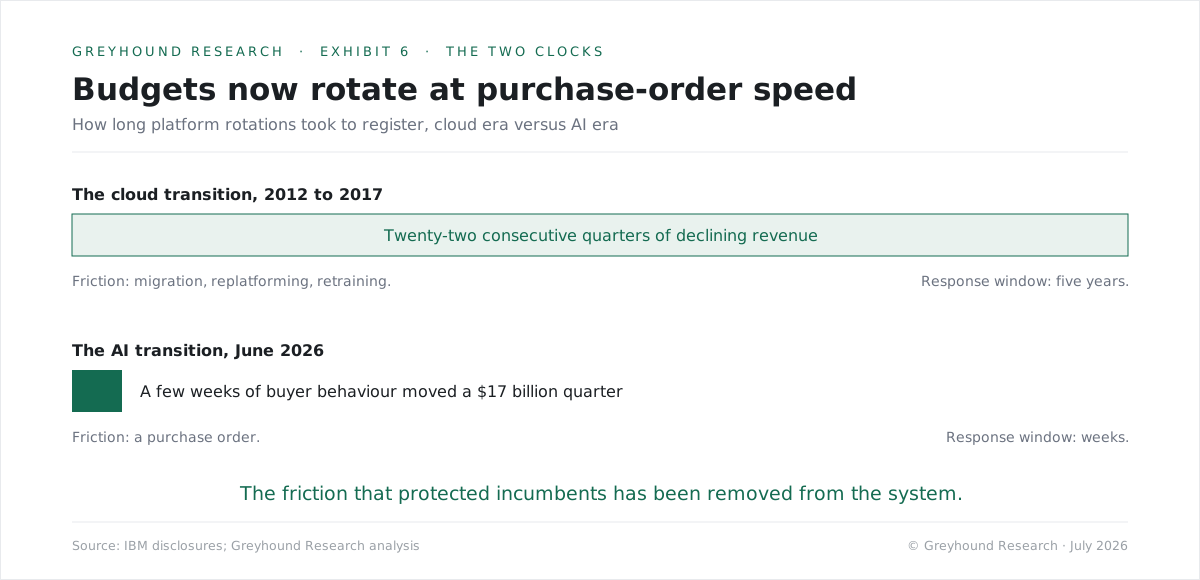
A line item that did not exist as a first-class entry two years ago, AI capacity with its memory, power, and silicon attached, now sits at the top of the stack and pulls funding toward itself mid-quarter. Line items that were untouchable for a decade, application renewals, steady-state software, standing services, are being interrogated one by one. And the reallocation no longer waits for planning season. June proved the point at scale: demand large enough to bend a Fortune 10 vendor’s quarter moved in under three weeks. Budget season is becoming continuous reallocation, and every operating rhythm built on the annual cycle, vendor account plans, renewal calendars, board reviews, now runs against a clock it was not designed for.
The agenda changed with the arithmetic. Greyhound CIO Pulse 2026 has the sequence in the buyers’ own numbers: 84 per cent of enterprise technology leaders have shifted their focus from AI adoption to AI accountability, 55 per cent name energy as the binding constraint on scale, and fewer than one in three can yet point to measurable outcomes across a majority of funded AI initiatives. Put the three together and the new agenda writes itself. Concentrate spend on the layer in shortest supply. Interrogate everything adjacent to it. Fund what converts, defer what does not, and defend every deferral with a return date. That is not a sentiment cycle. That is the operating model of the technology budget being rebuilt, and it will outlast every quarter it touches.
At Greyhound Research, our read is blunt: every technology vendor’s revenue line is now downstream of a budget being rebuilt around a different question, and July 14 made IBM the first large vendor to disclose contact with that rebuild in public.
Ericsson warned on the same economics the same morning. The vendors that compound through this era will be the ones whose products answer the budget’s new question, feed, secure, or govern the layer in shortest supply, and whose commercial machinery can move at the budget’s new tempo. That is the lens for every result this earnings season, and it is the lens this note has applied to IBM.
Greyhound Standpoint: At Greyhound Research, we believe the AI era has made markets structurally poor at reading enterprise technology. They price applause and panic at the same volume, because both are legible in a single session, while the things that actually decide outcomes, conversion, integration, delivery, and time, are not. Our method does not change with the mood. When Oracle was toasted, we checked the bill. Now that IBM is being mourned, we are checking the same bill.
This Was Never Only About IBM
Zoom out from Armonk and the pattern becomes unmistakable. July 14 was not an event; it was the sharpest single frame of a film that has been running all year.
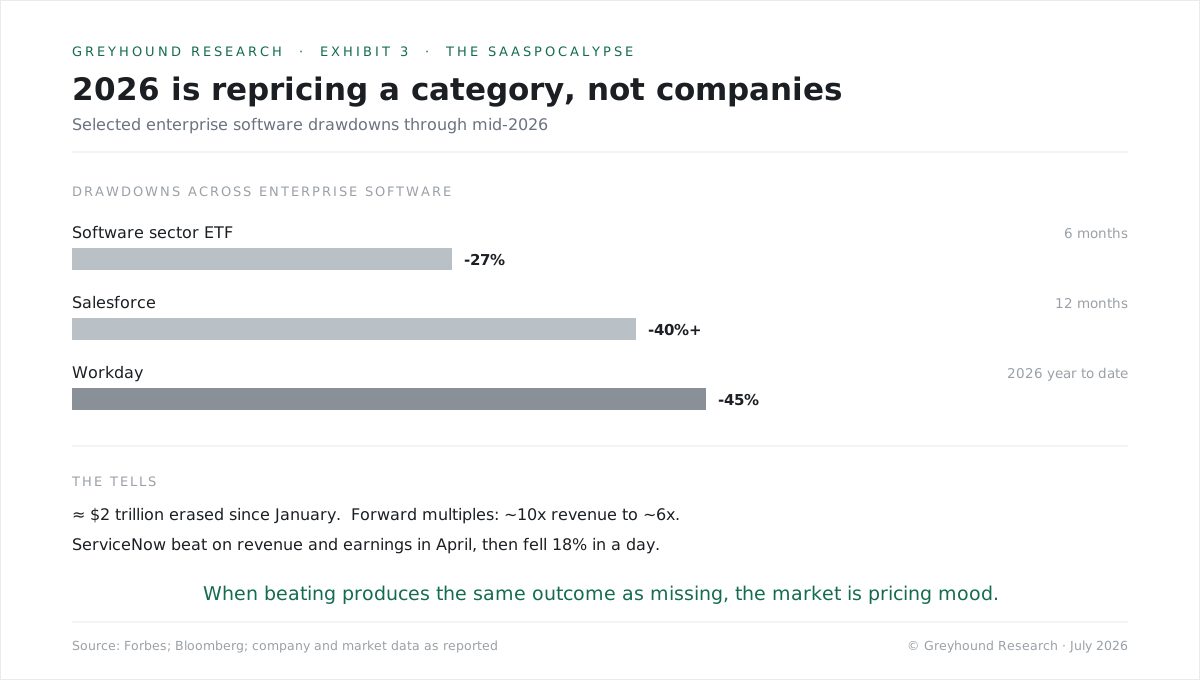
Wall Street has spent 2026 conducting a rolling repricing of the entire enterprise software complex, branded the SaaSpocalypse, which has erased by one count roughly $2 trillion of software market value since January on a single fear: that AI agents will dissolve the per-seat licensing model. In February, a set of frontier model releases triggered a selloff approaching a trillion dollars across enterprise software within days. Salesforce has fallen more than 40 per cent over twelve months. Workday is down roughly 45 per cent this year and more than 60 per cent from its early-2024 peak.
By mid-April, HubSpot, Atlassian, and Figma sat 70 to 80 per cent below their 52-week highs, the sector’s benchmark ETF had lost 27 per cent in six months, and forward multiples across enterprise software had compressed from roughly ten times revenue to six.
Two details in that record matter more than the totals. The first: the verdicts no longer respond to performance. In April, ServiceNow beat expectations on both revenue and earnings and fell 18 per cent the next day; IBM beat in the same week and fell alongside it. When beating the numbers produces the same outcome as missing them, the market is not pricing companies. It is pricing a category, on mood. The second: on July 14 itself, IBM’s preannouncement dragged Microsoft down 3 per cent in pre-market trading and pushed Oracle lower still, though neither had reported anything. Contagion without information is the definition of sentiment.
Set the tape against the buyers, and the gap this note has described all along reappears at sector scale. Greyhound CIO Pulse 2026 shows enterprises interrogating their software estates, not abandoning them; renewals are being examined, consolidated, and made to prove indispensability, which is a demand for outcomes, not an exit from software. And in the very latest sessions the tape itself has begun to blink, with capital rotating from the infrastructure layer into oversold application software, the earliest market acknowledgement of the second act this note describes, in which the money moves to whatever makes expensive capacity produce.
So read July 14 for what it was: not an IBM story, but the most violent chapter yet in a market-wide failure to distinguish between software that feeds, secures, and governs the scarce layer and software that merely sits beside it. That distinction will be drawn, vendor by vendor, over the coming quarters, and it will be drawn by buyers rather than by the tape.
Every chief executive of an enterprise software company, at Oracle, at Microsoft, at Workday, and far beyond, is sitting the same examination IBM sat on July 14. The playbook in this note, candour paired with conversion, commercial machinery rebuilt for the compressed clock, and outcomes proven rather than asserted, applies well beyond Armonk.
Greyhound Standpoint: At Greyhound Research, we believe 2026’s software repricing is a verdict on a category delivered before the evidence on its members is in. The dispersion will come, and it will be decided by the sorting question this note keeps returning to. Until then, single-day verdicts, whether on Oracle in September, on ServiceNow in April, or on IBM in July, tell you about the market’s nerves, not about enterprise demand.
Where We Stood Coming Into July 14
The word remains in our title is doing real work, because the position predates the panic, and so does the warning.
Our Q3 2025 note on IBM, published in November, carried a title that reads differently today than it did then: Delivery Strength Holds, But Integration Demands Intensify. The quarter itself was excellent. Revenue of $16.3 billion, up 9 per cent year on year. IBM Z up 59 per cent, the strongest two-quarter mainframe launch in two decades. Red Hat bookings up around 20 per cent. And yet Greyhound Research flagged one line of weakness inside all that strength: Transaction Processing fell 3 per cent, and it fell because clients were redirecting spend toward newer Z hardware.
Read that again, because it was published nine months before July 14. The precise mechanism that broke this quarter, clients moving money toward hardware and away from the software attached to it, was visible then, named then, and treated then as a footnote inside a strong print. It was not a footnote. It was the tell.
We drew the consequence in the same note. IBM’s ability to convert hardware momentum into recurring software monetisation, we wrote, remains the hinge between short-term strength and long-term valuation. That hinge is the whole story of July 14. The market has now discovered, violently, what our Greyhound Fieldnotes had already recorded: the Z cycle and the software attached to it do not move in lockstep, and the gap between them is where a quarter can be lost.
The rest of that note still stands. Greyhound Fieldnotes showed enterprise buyers treating IBM as an operational partner rather than a supplier of components, with Red Hat as the backbone of hybrid-cloud design and HashiCorp folded in as a control layer across clouds. Buyers had stopped assessing Red Hat, watsonx, and Consulting in isolation and started judging IBM’s ability to coordinate them into one experience. One CIO gave us the tension in a sentence: IBM’s architecture is integrated; its delivery still isn’t.
And we closed with a bar. IBM has proven it can execute; the question is whether it can make that execution feel effortless to the clients who depend on it.
July answered that honestly. Not yet. A quarter in which numerous large deals slip past their expected close is the opposite of effortless. But note what July did not overturn: not the system-buying pattern, not the operational-partner standing, not the architectural bet. Those remain live, and the preliminary disclosure, read closely, supports them.
The immediate run-in sharpens the point. In the first quarter of 2026, IBM grew revenue 9 per cent to $15.92 billion, with software up 11.3 per cent and infrastructure up 15.2 per cent on z17 momentum, and management called generative AI in mainframe modernisation accretive to the portfolio. Ninety days separated that print from this one. When a customer base reverses that fast, the prime mover is rarely the vendor. It is the market underneath the vendor.
The Anatomy Of The Miss
Greyhound Research’s assessment weighs the causes of the quarter in the following order.
Product cycle first. IBM itself guided to infrastructure decline as the z17 launch wrapped, because that is what mainframe programmes do; they surge and they settle. The surprise was magnitude, not direction. Critically, the programme’s health indicators remain exceptional, and both figures are IBM’s own disclosed numbers: z17 is tracking nearly 130 per cent of z16 programme-to-programme, and z16 was the strongest programme in IBM’s history; clients representing 85 per cent of installed MIPs are maintaining or growing capacity. A collapsing franchise does not produce those numbers. A franchise whose buyers postponed a quarter does.
When the layer in shortest supply begins to reprice, procurement stops behaving like strategy and starts behaving like inventory management. That is what IBM’s clients did in the final weeks of June. It is rational, it is defensive, and it is, by construction, temporary; a pull-forward borrows from future quarters, it does not manufacture new ones.
Execution third. The letter concedes the point without decoration, and we take the concession at face value. IBM misjudged the speed of the reprioritisation and let deals drift past the quarter boundary. This is a real failure, and it belongs to management. It is also the most fixable item on the list, and the only one entirely within IBM’s control.
Distraction fourth. The letter’s reference to industry-wide cybersecurity concerns is the least examined line in the disclosure and, we suspect, one of the more consequential. Enterprises confronting fast-moving vulnerability exposure do not sign large platform deals that month. They triage. The same dynamic, as we discuss below, also handed IBM its most interesting new product of the year.
The Shortage Itself Has A Shelf Life
The June panic priced scarcity as a permanent condition. At Greyhound Research, we read it differently: two forces already visible in the record argue that even the scarcity is on a clock.
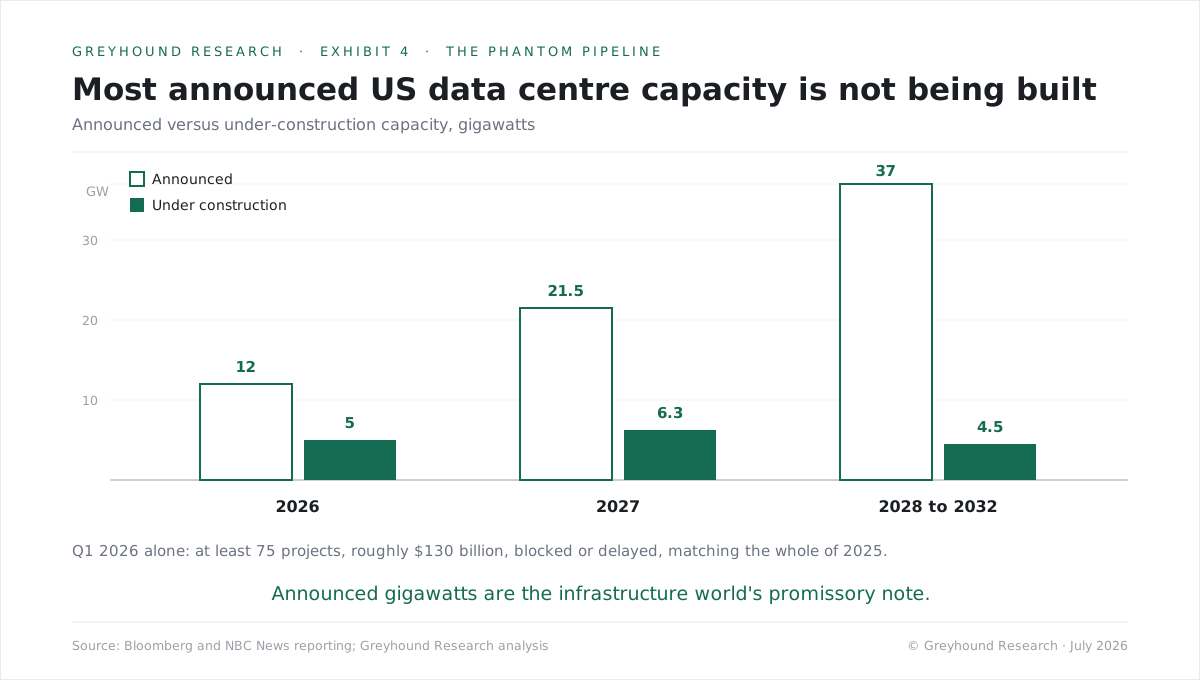
The first is that the announced supply was never going to arrive as announced. Bloomberg reported this spring that of the roughly 12 gigawatts of US data centre capacity slated to come online in 2026, only about 5 gigawatts is actually under construction, with between a third and a half of planned projects expected to slip or die. The forward pipeline is thinner still: 21.5 gigawatts announced for 2027 with only 6.3 broken ground, and 37 gigawatts planned for 2028 to 2032 with just 4.5 under construction. The constraint has migrated from chips and capital to the physical electrical layer; transformers and switchgear that took two years to procure before 2020 now take as long as five.
And the opposition has become an institution of its own. NBC News has reported at least 75 projects worth roughly $130 billion blocked or delayed in the first quarter of 2026 alone, as much as in the whole of 2025, with active local opposition groups more than doubling to 833 across 49 states, at least 69 local moratoriums in force, and Seattle imposing a one-year pause.
The second force sits on the consumption side, and it is quieter but heavier. Greyhound Research believes AI’s claim on enterprise technology budgets is expanding faster than the evidence of measurable business impact. Greyhound CIO Pulse 2026 finds that just 32 per cent of enterprise technology leaders say a majority of their materially funded AI initiatives have delivered measurable business outcomes against their approved business cases, based on responses from more than 1,000 leaders. While this represents an improvement from 25 per cent in 2025, it still means fewer than one in three technology leaders can point to measurable outcomes across most of their funded AI portfolio. Most enterprises have yet to move the bulk of their AI experiments into production, and a meaningful share of the agentic projects being stood up today will not survive contact with their own economics. The US Federal Reserve’s own monitoring records the same picture from the outside: firm-level adoption growth decelerated through 2025, and a plurality of workers use AI for an hour a week or less.
Usage is real and rising; it is simply rising slower than the capacity being provisioned for it. When consumption lags provisioning, the arithmetic ends one way: capacity hoarded against scarcity becomes capacity sitting under-used against interrogation.
Hold the two forces against the supplier warnings quoted earlier in this note, and the honest conclusion is uncomfortable for everyone with a confident forecast. The supply side warns of the worst memory shortage on record into 2027. The demand side shows announced capacity evaporating and usage trailing budgets. The market cannot decide whether the decade’s defining problem is scarcity or glut, and it has priced both verdicts, with total conviction, inside twelve months. That is not a market reading the future. That is a market reading its own mood.
We at Greyhound Research do not pretend this cuts only one way for our thesis. If consumption disappoints for long enough, some of the operationalisation demand we describe softens with it. But note what under-used capacity does to the outcomes economy: it intensifies the interrogation. Idle racks are the most visible unproven dollars in the enterprise, and boards do not respond to idle capacity by buying more of it; they respond by funding whatever makes it produce. Scarcity pays the hardware layer. Glut pays the layer that makes hardware answer for itself.
Greyhound Standpoint: At Greyhound Research, we believe the scarcity that broke IBM’s quarter is real today and fragile tomorrow. Between capacity that will not be built and consumption that has not kept pace, the squeeze that triggered June’s hoarding has a shelf life of its own, and every quarter it shortens, the case for reading July 14 as a permanent verdict weakens further. Panic has a shelf life. So does the shortage that caused it.
The Compression Of Transitions
Step back from IBM for a moment, because July 14 disclosed something about the industry that matters to every chief executive who reads this note.
There have always been two ways a platform transition could arrive in enterprise technology: slowly, across years of eroding quarters, or suddenly, in a single trading day.
Until this month, the industry had only ever experienced the first kind. The cloud transition registered against IBM as twenty-two consecutive quarters of shrinking revenue, and the bleed was slow for a structural reason: rotating to cloud demanded migration. Applications had to be replatformed, teams retrained, operations rewritten. That friction metered the pace of budget rotation, and in doing so it gave the incumbent years to respond. IBM used those years to remake itself.
The AI rotation carries no such friction. Securing scarce infrastructure requires no migration programme, no replatforming, no retraining. It requires a purchase order. Which is why a few weeks of buyer behaviour in June could move a $17 billion quarter, where the equivalent rotation in the cloud era took half a decade to register. The friction that once protected every incumbent’s response time has been removed from the system.
The implication is uncomfortable and general. Response windows in enterprise technology have collapsed from years to weeks. Strategy cycles, deal desks, supply sensing, pricing authority, and disclosure practice were all built for the slower clock. July 14 is what happens when a company, even a well-run one, meets the new clock with the old machinery.
For IBM specifically, the question July posed is whether its celebrated structural reflexes now operate at compressed speed. The evidence is split, and instructively so. The product reflex demonstrably does: weeks separated the arrival of new frontier AI capabilities from Lightwell’s general availability, a sequence the letter itself sets out. The commercial reflex, by the letter’s own admission, does not yet; the deal desk lost races it should have won. The remediation programme, which we address directly below, must close precisely that gap.
Six Arguments For Staying Bullish
The bearish reading of July 14 asks you to believe that one quarter’s timing reveals a franchise’s trajectory. We hold the opposite view, for six reasons, none of which is sentiment. Each argument that follows rests on disclosed numbers, observed buyer behaviour, or two decades of watching this company restructure its way through platform shifts. Each is falsifiable, and each carries its breaking condition in the July 22 watchlist later in this note. Together they describe a company standing in the path of the market’s next spending phase, not at the end of its last one.
One. The arithmetic of hoarding. There is only so much hardware an end-user enterprise can buy, and the buyers who moved IBM’s June were end-user enterprises, not hyperscalers or neoclouds building capacity for resale. Budgets cap it. Data centre space and power cap it. Depreciation schedules and chief financial officers cap it. A capex pull-forward is, by definition, borrowed demand; the racks purchased in June are the racks not purchased in December. Hoarding is a one-time repositioning of inventory posture against a shortage, not a new demand curve. The market extrapolated a reflex into a regime.
Two. The sunset of own-and-operate. The June rush ran directly against the decade-long direction of enterprise operating models. The era in which technology decision makers wanted to own and operate large hardware estates is on aggressive sunset. In Greyhound Fieldnotes, CIOs describe the June purchases in the language of insurance, not conversion: capacity secured against price rises, for infrastructure they have no intention of running the old way. A purchase made against the secular current is a hedge. Hedges do not found eras.
Three. The board reset and the outcomes economy. AI has rewritten what boards expect of their organisations. Every enterprise now carries an instruction that borders on the existential: adapt the business model, almost overnight, or become the technology’s victim. That instruction is precisely what sent buyers racing for capacity. But the same boards are enforcing accountability for every dollar at levels this industry has never seen, and our own buyers told us so before the market noticed.
Greyhound CIO Pulse 2026, across more than 1,000 enterprise technology leaders, finds 84 per cent have shifted their focus from AI adoption to AI accountability, up from 78 per cent a year earlier, concentrating on how AI integrates with existing systems of record and whether it can operate under the same governance standards that regulate their core data.
That is the whole thesis of this note, stated by the buyers themselves, nine months early. Spending is running ahead of proof, and boards know it. Capacity bought under pressure will be interrogated under pressure.
Four. The operationalisation clock. A rack produces nothing on arrival. Integration, security, and governance come first; data engineering, skills, and amperage follow; the whole takes quarters, and quarters are exactly what CIOs do not have. The board clock is set to months. Greyhound CIO Pulse 2026 finds 55 per cent of CIOs citing energy cost and availability as their single biggest barrier to AI scale, up from 47 per cent a year ago; the constraint has not only moved from the purchase to the deployment, it is tightening. Buying the rack was never the hard part.
That gap closes only one way: with software, platforms, and partners. This is not our hope; it is the industry’s revealed behaviour. Demand is concentrating around targeted AI investments rather than broad programmes. Tata Consultancy Services is building a team of up to 8,900 forward-deployed engineers to implement AI inside client environments. Cognizant is acquiring Astreya to deepen AI infrastructure capability. The services industry is staffing for the operationalisation wave because the operationalisation wave is where the money goes next. IBM’s core, hybrid platform software plus consulting plus infrastructure attach, sits directly in its path.
Five. The print already shows rotation, not ruin. The most under-read paragraph of Krishna’s letter is the strength list. Distributed Infrastructure posted the best performance in its reported history, up 37 per cent with strong growth in Power and Storage, against 8 per cent growth in the same business in Q3 2025. That is not a drift; it is an inflection.
The late-June scramble did not merely bypass IBM. A meaningful share of it landed inside IBM’s own distributed portfolio, alongside Red Hat accelerating to 11 per cent, strong performance from HashiCorp and Confluent, consulting signings growing on GenAI, and operating margin expanding through the shortfall. The quarter’s money moved within IBM at least as much as it moved away from it.
The same paragraph reports a backlog of approximately $500 million exiting the quarter, and here we must apply our own rule to a company we are defending. Backlog isn’t bank balance. Greyhound Research wrote that about Oracle in September 2025, and the discipline does not soften because the conclusion this time is favourable. IBM’s half a billion is a promissory note, not money. It is unbanked until it converts.
What differs is the character of the promise, not its nature. Oracle’s backlog was concentrated on a single client who was not yet profitable, denominated in hundreds of billions, and contingent on building gigawatts of capacity that did not exist. IBM’s is a few hundred million, spread across existing clients on a diversified installed base, for Power and Storage systems the company already manufactures, requiring no speculative capex to fulfil. One promise needs a decade and a miracle. The other needs a supply chain and two quarters. Both, though, are promises, and neither is proof.
So we hold this evidence at exactly the weight it deserves: the backlog tells us the direction of demand, not the fact of revenue. If it ages rather than converts, our reading is wrong, and that condition sits in the July 22 watchlist below, with the others.
Six. The structural reflex. This company’s defining trait across our two decades of coverage is not any single product. It is the reflex to answer platform shifts with structure. PwC Consulting in, 2002. Personal computers out to Lenovo, 2005. SoftLayer and the public-cloud chase in, 2013; x86 servers out, 2014; the hyperscaler chase conceded and its brands retired by 2017. Red Hat in, 2019. Kyndryl out, 2021. HashiCorp and Confluent in since. Through the cloud transition, revenue shrank for twenty-two consecutive quarters, the harshest weather any large enterprise vendor of its era endured, and IBM emerged with software at its centre and a hybrid platform under it. The reflex is visibly intact in the present tense: on July 15, the day after the letter, IBM launched new Power systems and software for enterprise risk, productivity, and flexibility, fresh supply pointed straight at the demand that produced the record quarter and the backlog.
Within weeks of the introduction of Mythos, the frontier AI generation the letter itself names, resetting the terms of open source security, IBM and Red Hat stood up Lightwell: a $5 billion commitment, more than 20,000 engineers, a trusted enterprise clearinghouse for open source software vulnerabilities, generally available from July 8. The quarter’s cybersecurity headwind became the quarter’s most interesting product. That is the reflex working at modern speed. Quantum sits behind it as optionality, not load-bearing thesis: more than $10 billion committed over five years, a foundry letter of intent alongside the US Department of Commerce, spanning research and development, capital expenditure, manufacturing scale-up, acquisitions, and ecosystem, and a 2029 target for large-scale fault tolerance. The letter’s framing does not hedge: quantum computing “is no longer decades away, it is upon us”.
We do not need quantum for this case; we simply note that the company being priced for decline is the one making the decade’s most aggressive frontier commitments.
Greyhound Standpoint: At Greyhound Research, we believe the bullish case for IBM after July 14 is not a bet against the AI infrastructure wave. It is a bet on the wave’s second act. Hardware can be hoarded; outcomes cannot. In the AI era, outcomes are the only currency boards accept, and outcomes are manufactured in the layers IBM occupies: the platform, the integration, the governance, the operating discipline. June paid the scarce layer first. The quarters ahead must pay the layer that makes scarcity useful.
The Competitive Map After July 14
Start with the category error, because it explains the violence of the repricing, and because IBM has lived it before. On July 14 the market measured IBM with a yardstick built for someone else. IBM is not a hyperscaler. It is not a neocloud. It does not sell raw capacity by the gigawatt, does not win by owning the most accelerators, and the capital arithmetic quoted earlier in this note is the opposite of the capacity race. The infrastructure outcomes IBM optimises for are different in kind: transaction integrity at transaction latency, sovereign and regulated compute, estates that must be governed and audited rather than merely provisioned.
IBM knows the difference because it once paid the tuition. In 2013 it bought SoftLayer, then the largest privately held infrastructure cloud in the world, and took the hyperscaler fight to Amazon directly, full-page newspaper advertisements included, after losing the CIA’s cloud contract. By 2017 the SoftLayer and Bluemix brands were retired into IBM Cloud; by 2019 the answer was Red Hat and hybrid. The company tried the yardstick, conceded the race, and rebuilt around a different definition of infrastructure.
Measured on the hyperscaler yardstick, IBM will always look like it is losing. Measured on the outcomes its buyers actually purchase, the yardstick inverts. The buyers know the difference. On July 14, the tape did not.
Every rotation produces a scoreboard, and June’s is legible. The immediate winners were the constituents of the scarce layer: memory makers repricing multi-year supply, distributed infrastructure vendors shipping into the rush, and the foundry base running at records. The immediate casualties were vendors whose revenue depends on considered, quarter-end decisions: platform deals, large software renewals, transformation programmes. IBM had the misfortune of being the most visible vendor with exposure on both sides of that line, and the market punished the visible side while ignoring the other.
Because the other side matters. IBM is one of very few vendors that participated in the rush and owns the layer that follows it. Its Distributed Infrastructure business took a record share of June’s scramble and banked a backlog; its platform, integration, and consulting businesses stand where the operationalisation demand arrives next. Vendors that only shipped boxes in June met the demand once. Vendors that attach software, governance, and services to those boxes keep it.
And there is a structural fact the industry’s capex race obscures: IBM competes in this era on strikingly little capital of its own: by its own preliminary disclosure, the half produced $7.8 billion of net operating cash and $4.8 billion of free cash flow, against net capital expenditure of just $743 million. It is one of the few large vendors that does not need to buy its way into the AI build-out. It needs to attach to it.
Then there is the question the market has not asked: where does compute gravity actually pull? The honest answer, for much of the market, is toward hyperscale estates. IBM’s counterweight is deliberate and, in our view, underpriced by the narrative: neutrality and sovereignty. For regulated industries, for governments, and for enterprises whose boards have begun asking uncomfortable questions about concentration risk in the AI supply chain, the non-hyperscaler platform that respects architectural boundaries is not a legacy position. It is a governance position, and governance is precisely what the outcomes era audits.
Which brings us to the single most revealing detail in the entire disclosure, and it is not a number. Read Lightwell’s early-adopter list: Bank of America, BNY, Citi, Goldman Sachs, JPMorganChase, Mastercard, Morgan Stanley, Royal Bank of Canada, State Street, Visa, Wells Fargo. That is not a general-market logo wall. That is the systemically important core of global finance, the same constituency that anchors the Z estate and its installed MIPs base. The institutions the market believes are abandoning IBM’s centre spent early July signing into IBM’s newest governance layer. Constituencies do not deepen their relationship with a platform they are exiting.
The Machinery Beneath The Argument
Everything above is strategy, and strategy without machinery is a press release. A note that asks readers to stay bullish on a franchise owes them a tour of what that franchise actually ships. So here is the stack, layer by layer, in the terms a buyer would use.
The silicon layer. Start where the quarter broke, because the Z estate is not what the tape thinks it is.
z17 is not a faster mainframe; it is a wager about where inference belongs. Telum II executes AI inference on the processor itself, in the path of the transaction, so fraud scoring and anti-money-laundering models run at transaction latency without sensitive data ever leaving the platform. The Spyre accelerator extends that footprint from predictive scoring toward generative use cases on the same estate. The programme metrics quoted earlier in this note, the near-130 per cent programme-to-programme trajectory and the MIPs base holding or growing, are the commercial readout of that wager.
And the estate is bending toward deployment flexibility: IBM now offers z17 and LinuxONE 5 in rack-mount configurations for the first time, which matters because the argument between data-centre floor systems and rack economics is precisely the argument June’s buyers were having with their CFOs. Alongside the hardware sits watsonx Code Assistant for Z, which modernises decades-old estates in place rather than forcing a migration; State Street has been using it to renovate mainframe applications on-platform. The estate’s future, on this evidence, is renovated rather than vacated.
The open question our Greyhound Fieldnotes carry from North American buyers is composition rather than capability: financial institutions and federal agencies satisfied with z17’s confidential inferencing want a clearer account of how Spyre, OpenShift AI, and watsonx behave as one system across hybrid estates. Confidence in the compute has been earned. Confidence in the composition is the next test.
Beside Z sits the distributed portfolio that produced the quarter’s record. Power11 is positioned for exactly the workloads June’s buyers were securing: data-sovereign computing, SAP RISE estates, and controlled environments where energy per unit of work is a design constraint rather than a footnote. With energy the top barrier to AI scale for CIOs in Greyhound CIO Pulse 2026, a platform engineered around that constraint is not a legacy line. It is where a meaningful share of the late-June money landed, and the 37 per cent record quarter is the receipt.
The platform layer. Above the silicon sits the substrate that makes the portfolio one thing rather than five. Red Hat OpenShift is the hybrid foundation, with recurring revenue past $1.8 billion as of our Q3 2025 coverage, having grown more than 30 per cent over the prior year and Red Hat growth now accelerated to 11 per cent through a down quarter. HashiCorp gives that substrate its control layer: one place to manage infrastructure and application policy across clouds, which is the capability enterprises reach for the moment their AI estate spans more than one provider.
Confluent adds the data in motion, streaming operational events into AI systems in real time rather than in batches, and the acquisition closed into this posture during the first quarter, so the stream is now owned rather than partnered. Substrate, control plane, and stream: that is the anatomy of the integration buyers told our Greyhound Fieldnotes they now judge IBM on, and it is why the letter’s line that HashiCorp and Confluent performed strongly through the miss carries more information than its length suggests.
One more fact completes the layer, and it is strategic rather than technical: watsonx is deliberately embedded within AWS, Azure, Oracle, Salesforce, and ServiceNow rather than walled against them, positioning IBM’s governance and orchestration as the layer that keeps enterprise AI compliant, auditable, and connected across clouds IBM does not own. The moat is placement, not exclusivity.
The intelligence layer. watsonx is the family the market keeps mispricing as a chatbot brand. Orchestrate puts agents into business workflows. watsonx.governance is the audit and explainability layer that European banks and regulators have pulled toward rather than resisted. And underneath them, the Granite 4.0 models carry the quarter’s best-hidden product fact: they run on roughly 70 per cent less memory at about twice the inference speed of conventional architectures.
Read that against everything this note has said about the memory market. In a cycle where memory is the binding constraint, where its price broke IBM’s own quarter, model efficiency stops being benchmark vanity and becomes procurement relief. The vendor whose models sip memory is selling a hedge against the very scarcity that bruised it. Nor is IBM alone in engineering around the constraint; Qualcomm has signalled AI silicon designed for cheaper memory tiers, which tells you where the industry’s centre of effort is moving.
IBM’s inference stack extends through partnerships with Groq for high-throughput serving and Anthropic for conversational systems, and the commercial scale is no longer hypothetical: IBM’s generative AI book of business stood at more than $12.5 billion by the close of 2025.
Deutsche Telekom runs watsonx for predictive network reliability. S&P Global has embedded watsonx Assistant into its reporting workflows. IBM also runs this machinery on itself: the Client Zero programme has automated more than seventy internal workflows for around $4. And the layer the February fear actually points at, agents, is one where the company has already fielded both halves of an answer. Bob, IBM’s AI development partner, went generally available in April after eleven months as Client Zero’s sternest test: more than 80,000 IBM employees now use it, reporting an average 45 per cent productivity gain, with each task routed across frontier and open models, Anthropic’s Claude, Mistral, and IBM’s own Granite among them, by accuracy, cost, and speed.
The agent control plane in watsonx Orchestrate applies the placement logic one layer up: it observes, governs, and cost-controls agents wherever they were built and wherever they run, the moat-is-placement wager restated for the agent estate. The company the tape priced as the agent era’s prey ships both the tool that builds for that era and the control plane that governs it. And this month the same machinery reached the estate where the quarter broke: Bob’s premium package for Z went generally available, superseding watsonx Code Assistant for Z and pointing agentic development directly at the decades of COBOL and PL/I the Z franchise carries.5 billion in annualised savings, which means the reference case for the portfolio is IBM’s own operating statement.
One honest entry belongs on this layer’s ledger, because our Greyhound Fieldnotes have carried it from European buyers for three consecutive quarters: the complaint is packaging, not capability, with overlapping modules and licensing structures that clients describe as harder to buy than to run. The catalogue is strong. Its commercial wrapper is still catching up, and July 22 would be a fine moment for IBM to say how.
The trust layer. Lightwell deserves the product detail the headlines skipped, because its mechanics explain its adopter list. Lightwell Network, now generally available, is a catalogue of more than 6,500 remediated, digitally signed, and certified application-layer dependencies across the Java and Python ecosystems: not advisories about vulnerabilities, but fixed components an enterprise can consume.
The economics underneath explain the urgency. By the companies’ own count, open source now constitutes as much as 90 per cent of enterprise codebases, the average codebase carries 581 known vulnerabilities, and AI-generated exploits trade for as little as $50. Lightwell Clearinghouse Premier, in limited availability and financial services first, acts as the trusted intermediary for secured patch embargoes and coordinated response across an industry.
Underneath both runs a remediation engine that combines frontier and open AI models with human engineering to find, validate, and fix flaws at a pace no single institution can match. That is why eleven of the most systemically important names in global finance signed at launch: the quarter’s cybersecurity distraction is, for them, a permanent operating condition, and Lightwell converts it from each bank’s problem into a shared utility.
The frontier layer. Anderon completes the stack as optionality with real specifications: a standalone company headquartered in Albany, the world’s first pure-play quantum wafer foundry, backed by $1 billion in CHIPS incentives from the US Department of Commerce and matched by $1 billion of IBM’s own cash, operating at 300 millimetres and offering fabrication to multiple quantum vendors rather than IBM alone, beginning with superconducting qubit wafers and related electronics before expanding into other quantum technologies. And one discipline this note applies everywhere applies here too: the arrangement is a letter of intent, with definitive documents still to be negotiated and executed, which makes it, by our own standard, a promise on its way to proof rather than proof itself. The thesis in this note does not need quantum to work.
What should a CIO do with this tour? Notice that the stack’s economics are attach economics. Each layer makes the next cheaper to adopt: the silicon makes the platform sticky, the platform makes the intelligence governable, the intelligence makes the trust layer necessary, and every layer generates the consulting that operationalises the rest. That is what the July 22 attach question in this note is actually testing, product by product.
Greyhound Standpoint: At Greyhound Research, we believe the product answer to July 14 is already shipping. Inference beside the transaction. Models that economise on the scarcest input in the industry. A control plane that spans clouds. A trust layer built from the quarter’s own headwind. The market priced a franchise in decline; the catalogue describes a franchise in position. Machinery, not messaging.
The Architecture Question We Are Watching
A serious bullish case names its risk, and ours is architectural.
For decades, enterprise computing obeyed a single law: compute moves to data. That law is why the mainframe outlived every obituary written for it; the systems of record sat there, so the workloads stayed, so the budgets followed. Data gravity was the moat. The AI build-out introduces a countervailing force. Scarce accelerators and scarce memory exert their own pull, and data pipelines, workloads, modernisation roadmaps, and budgets have begun drifting toward wherever scarce compute can be secured. Call it compute gravity.
IBM’s product strategy is a deliberate wager against that drift: bring AI to the transaction, with Telum II and Spyre executing inference beside the workload, and code assistants modernising the estate in place. June’s buying behaviour is the first quarter-scale evidence of clients running the opposite play, moving spend, and potentially data, toward the scarce layer.
If June was a scarcity reflex, the wager holds and the deferred demand returns. If June was the first visible movement of a structural rotation away from centralised transaction processing, then Transaction Processing economics erode across years rather than quarters, and our thesis requires revision. Greyhound Research weights the first reading substantially higher today, on the strength of the z17 programme metrics and the MIPs base. But we hold the second reading open, in writing, on purpose.
Greyhound Standpoint: At Greyhound Research, we believe the defining architecture question of the next three years is whether AI comes to the transaction or the transaction’s data goes to the AI. IBM has bet its infrastructure franchise on the first answer. One quarter cannot settle the question, and honest analysis refuses to pretend otherwise.
The Recovery Runs On A Slower Clock
Honesty about the fall demands equal honesty about the repair, so let us set expectations plainly: the revival will be measured in quarters, not in months, and certainly not in weeks.
The compression we described earlier runs one way. Budgets can leave at the speed of a purchase order; they return at the speed of deployment. What flows back to IBM is not hardware grabbed off a truck but deals, platforms, and programmes, and those carry natural cycle times that no urgency can shorten: procurement reviews, security assessments, integration schedules, the hiring and training of people. The operationalisation clock that guarantees the demand also paces it.
Four further weights sit on the timetable. Slipped large deals re-close across one or two quarters at best, not in the weeks after a conference call. The pull-forward must be paid back; some of the racks that would have been bought in December were bought in June, so near-term infrastructure comparisons are owed a hole before they are owed a recovery. The memory shortage runs into 2027 on the supply chain’s own warnings, which keeps procurement noisy and the temptation to hoard alive.
And the same board-level interrogation of every dollar that guarantees the outcomes era will also lengthen approval paths, even for the software and services that ultimately win it.
None of this weakens the thesis. It disciplines it. A reader expecting July 22 to deliver the full repair is making the mirror image of the market’s error on July 14: misreading the clock. The fall was priced in a day, because falling requires only a session. The repair will be priced across quarters, because repairing requires work. We would rather be right on that timetable than loud on a shorter one.
Three Scenarios To 2027
Analysis that reaches an executive desk should say what happens next, with weights and signposts, and accept the accountability that follows. Greyhound Research’s are below.
Scenario one: reflex and recovery. The supply panic normalises as multi-year contracts replace spot hoarding. Slipped deals close through the second half of 2026; the z17 wrap settles to its guided trajectory; the Distributed Infrastructure backlog converts; software reaccelerates as operationalisation budgets arrive. By early 2027, this quarter reads as timing. The forces described in The Shortage Itself Has A Shelf Life, announced capacity evaporating and consumption trailing provisioning, are this scenario’s quiet accelerants. We assign this scenario the bulk of the probability. Signposts: deal closures disclosed on July 22, backlog growth rather than ageing, Red Hat holding double digits, Transaction Processing stabilising within two quarters.
Scenario two: the extended squeeze. The shortage deepens on the trajectory SK Hynix has warned of, pulling repeated hoarding waves through 2027. Deal timing stays noisy for several quarters across every platform vendor, margins absorb continued mix pressure, and one sting lands specifically on IBM: its own Power, Storage, and Z systems compete for the same scarce memory its clients are pre-buying, so the record backlog converts more slowly than it was signed. Direction intact; path uglier. We assign this a meaningful minority of the probability. Signposts: memory pricing through late 2026, backlog ageing beyond two quarters, a second consecutive infrastructure miss.
Scenario three: structural rotation. Compute gravity proves durable rather than cyclical. Transaction Processing enters a multi-year erosion, the MIPs base begins to shrink, and IBM is forced toward its next structural move, an acquisition into the scarce layer or a shedding of what the rotation has stranded. Its history says it would make that move rather than deny the need for it. We assign this a tail probability, and we refuse to round the tail to zero. Signposts: the second tell below breaking on both its faces, the programme metrics and Transaction Processing together.
What We Are Watching On July 22
IBM’s full results and conference call arrive on July 22 at 5 pm Eastern, and we will be listening for six tells. Each carries its threshold: the reading that confirms the thesis, and the reading that breaks it. Bullishness without checkpoints is cheerleading; these are Greyhound Research’s, in writing.
The first is deal motion since quarter end: how many of the slipped transactions have closed in the first three weeks of July, and at what aggregate value. That single disclosure separates timing from trajectory, and everything else on the call is commentary by comparison. If the slipped deals prove cancelled or materially resized rather than delayed, or no meaningful closures are disclosed, timing becomes trajectory.
The second is the Z estate’s full picture: how much of the miss sat in Z hardware, how much in Transaction Processing software, how much in consulting timing, and where the programme metrics now stand. Programme performance decaying toward z16 levels in successive quarters, or the share of installed MIPs maintaining or growing capacity falling from 85 per cent, breaks the cycle reading. And the trajectory we are watching hardest is Transaction Processing, because we named it first, in our Q3 2025 note. If that weakness outlives the z17 wrap, the hinge we identified nine months ago has not merely swung, it has broken: hardware momentum would be consuming the software attached to it rather than pulling it along. At that point this stops being a cycle and becomes a rotation.
The third is the character of the redirected client capex: whether IBM can evidence that June’s purchases were general price hedging across servers, storage, and memory rather than a targeted architectural exit. The letter’s language supports the former; the call should quantify it.
The fourth is the backlog, and its supply chain: the trajectory of the approximately $500 million in Distributed Infrastructure, whether it has grown since June 30, and whether IBM has secured the memory and components required to convert it. The shortage that created the backlog must not become the thing that gates it. If it ages rather than converts across two quarters, or shrinks as memory prices normalise, then the deferral was demand on paper, and the promissory note was never money.
The fifth is attach: whether Red Hat, watsonx, HashiCorp, and Confluent are landing on the capacity clients just secured, the second act made measurable. Red Hat decelerating from the 11 per cent it has just accelerated to would tell us capacity spending has reached platform renewals after all; consulting signings failing to convert into revenue across two or more quarters would tell us the operationalisation demand is being captured elsewhere, or insourced.
And the sixth is guidance posture: reaffirmed, rebased, or withdrawn, and with what treatment of the cybersecurity distraction and the Lightwell pipeline.
Table 4 condenses the six into the scorecard we will grade against.
To IBM’s Leadership: The Initiatives That Matter
The letter commits to new and accelerated initiatives without naming them. Since this note may reach the desks where those initiatives are being drafted, here is what we believe they must include. Little of it is new counsel; most of it is critique Greyhound Research has already published, in August and November 2025, and July 14 is what those findings look like when they compound.
Rebuild demand sensing. A company whose portfolio sells decision intelligence did not detect a capex reprioritisation moving through its own pipeline until the final weeks of a quarter. Instrument the pipeline the way IBM asks clients to instrument their operations: leading indicators, procurement-side signals, supply-chain telemetry feeding the forecast weekly, not quarterly.
Fix the accountability seams, because the deepest initiative is one the letter does not name. In August 2025 Greyhound Research documented post-pilot delivery faltering on fractured accountability between Red Hat, Consulting, and watsonx teams, with enterprise accounts running escalation loops simply to establish who owned the architecture; we wrote then that this is not a product flaw, it is a coordination gap. By November, buyers across India, Singapore, and Malaysia were describing timelines running longer than expected, with delays traced to coordination between global and regional delivery, while buyers in Australia and the UAE told us local solutioning depth still trailed their intent. The deal-desk races lost in June and the flat consulting conversion are the same gap, now priced in public. Whatever the accelerated initiatives contain, a single owner for the seam between hardware, software, and services belongs at the top of the list.
Re-engineer the deal desk for the compressed clock. If transitions now move at the speed of a purchase order, quarter-end commercial machinery built for a slower era will keep losing races it should win. Velocity, delegated authority, and pre-approved flexibility bands are now competitive weapons, not administrative details. We flagged the shape of this in August 2025, when consulting renewals in Spain and Italy slipped on pricing and go-to-market terms misaligned with procurement cycles; June was the same machinery losing faster races.
Take the friction out of staying. Accelerate consumption-based and as-a-service commercial models for the Z estate, so that a client hoarding capex elsewhere never has to choose between securing the scarce layer and refreshing the system of record. Deferral should be made commercially unnecessary. The strongest answer to a capex panic is a platform that does not require capex.
Deploy IBM Financing as the operationalisation bridge. Clients have exhausted capital envelopes buying hardware; the platform and services demand this note describes will arrive constrained by financing capacity, not by intent. IBM owns a financing arm. In this cycle it is strategy, not plumbing.
Secure the backlog’s supply chain, and say so on July 22. A record backlog is an asset only if it converts, and it converts only if IBM wins its own share of the scarce components.
And protect the candour, pairing it with proof. The letter’s tone earned more goodwill than choreography would have; candour is rewarded when conversion follows it. Then meet the bar we set in our third-quarter 2025 note: make execution feel effortless. July 14 is what missing that bar looks like in public.
To The Technology Buyer: Five Moves While The Window Is Open
For the technology buyers Greyhound Research advises, the counsel is fivefold, and the window for most of it is measured in days, not quarters. Because this note concerns IBM, each move carries its IBM-specific application: the ask a buyer should put on the table now, and every one of them an ask a vendor defending a franchise can say yes to.
Treat AI infrastructure as a full-stack cost object rather than a hardware line. Memory, storage, power, networking, security, model operations, and staffing belong in one total-cost view, reviewed at board cadence, because June just demonstrated what fragmented views miss: a capex reprioritisation large enough to move a seventeen-billion-dollar quarter travelled through enterprise pipelines without most governance processes registering it until vendors disclosed it. If the estate is priced in pieces, it will be repriced by events. The total-cost view is the instrument that lets a buyer distinguish a genuine scarcity premium from a panic premium, which is precisely the distinction the market itself failed on July 14. With IBM, the application is direct: ask for the estate on one commercial sheet, hardware, software, services, and financing quoted as a system against your total-cost view, with delivery dates in writing, because the disclosure has already told you supply is constrained, and a constrained vendor commits in writing or not at all.
Ring-fence the software that makes scarce capacity productive: security, data, integration, observability, governance. When budgets tighten around hardware, the reflex is to cut horizontally, and the horizontal cut lands hardest on exactly the layers that convert racks into outcomes. Cut duplication rather than muscle; most estates carry two or three overlapping tools per category, and consolidation funds the squeeze without touching capability. The hoarded capacity of June becomes the stranded capacity of December only if the software that operationalises it is starved in between. With IBM, trade proof for price: the company needs attach evidence, Red Hat, watsonx, and Lightwell landing on newly secured capacity, more than it needs list price this half, and a buyer willing to stand as a named reference or a measured case should extract pilot economics and success-based terms for exactly the layers this move ring-fences.
Put one question to every renewal and every programme: does this feed, secure, or govern the scarce layer of the stack, or does it merely sit beside it? Fund the first group ahead of the queue. This is the buyer-side version of the adjacency re-ranking the market performed in June, applied deliberately rather than in panic. A spend item that cannot answer the question is not automatically cut, but it queues behind everything that can, and the queue itself becomes the governance. With IBM, run the test on IBM’s own paper: ask the account team to map every renewal line to feed, secure, or govern, and let whatever merely sits beside it fund the consolidation. The in-path inference case for Telum and Spyre is theirs to prove; ask for benchmark commitments on your workloads, not the brochure’s.
Discipline the deferrals. Give every postponement a return date, because a refresh deferred without one is not a deferral; it is an abandonment happening slowly, and it will surface as risk in an audit rather than a plan. Assign each deferred item an owner and a trigger, the price point or supply signal at which it returns to the front of the queue, and review that register with the same seriousness as new spend. IBM’s own quarter is the cautionary case read from the vendor side: deferred demand is real, but only the buyers who tracked what they deferred will convert the recovery on their own terms rather than the market’s. With IBM, make the vendor underwrite its own thesis. The letter calls the lost demand deferred, not destroyed; a vendor that believes that should have no difficulty attaching price protection and a guaranteed build slot to your return date. If the account team hesitates to contract on IBM’s own reading of the quarter, the hesitation is information.
And use the moment: negotiate now. The weeks after a vendor’s public stumble are the strongest commercial window a buyer receives, and this one has a visible closing date, because July 22 either restores the vendor’s footing or resets the terms entirely. Seek multi-year price protection, capacity guarantees, and flexibility clauses while it is open, specifically and respectfully: specifically, because vague asks waste the moment; respectfully, because the counterparty across the table will remember the tone long after it remembers the discount. A buyer who arrives with the total-cost view from the first move and the deferral register from the fourth negotiates from evidence rather than opportunism. And with IBM, the service ask matters as much as the price ask: a single named executive accountable for the seam between Red Hat, Consulting, and watsonx on your account, with an escalation clock attached, because the coordination gap Greyhound Research has documented since August 2025 is contracted away far more reliably than it is reorganised away. Put the asks on the table before July 22, while the answers are still being drafted.
Greyhound Standpoint
At Greyhound Research, we believe July 14 priced a permanent verdict on a temporary reflex. The arithmetic of hoarding, the sunset of own-and-operate, the board-level reset toward outcomes, the operationalisation clock, the evidence of the preliminary print, and a two-decade record of structural adaptation all point the same way: the demand IBM lost in June was deferred, not destroyed, and it returns with urgency attached, on a clock measured in quarters rather than weeks, into precisely the layers where IBM has spent seven years concentrating its portfolio.
Transitions now arrive at the speed of a purchase order, and the vendors that endure will be those whose reflexes, commercial as much as productive, run at that tempo.
The company faltered on timing and said so plainly. The market answered by erasing a quarter of its value over a quarter in which it grew. One of those two reactions was proportionate.
Ten months ago the same market was pouring champagne over a backlog it had mistaken for a bank balance, and we said so while the market was still applauding. Today it is holding a wake over a deferral it has mistaken for a death. We are not switching sides. We are applying the same rule we applied then, the only rule that survives both moods: applause is not delivery, and panic is not diagnosis. Count what converts.
We remain bullish on IBM. Not on its share price, which is not our trade, but on its franchise, which is our field. Hardware can be hoarded. Outcomes cannot. And the outcomes era has only just presented its bill.
Important Disclaimer
Greyhound Research are industry analysts, not equity analysts. This note is a demand-side assessment of IBM’s franchise and strategy, built on IBM’s preliminary disclosure; final figures may differ, and we will update this position after the company’s full results on July 22. It is not investment advice, and nothing in it should be read as a view on securities.
This is a strictly independent analysis. IBM has not commissioned, paid for, reviewed, or influenced this note in any form, and Greyhound Research has received no compensation from IBM or any other party for its production. The views expressed are Greyhound Research’s alone.
This note draws on Greyhound Research’s published IBM coverage, including our Q3 2025 results note, and on Backlog Isn’t Bank Balance (September 2025). Buyer evidence is drawn from Greyhound CIO Pulse 2026 and Greyhound Fieldnotes. Our full archive is available at greyhoundresearch.com.
Sources And References
Every load-bearing claim in this note traces to one of the sources below, presented in Harvard reference format and grouped by class. The class matters: company disclosures and government records carry different evidential weight from press reporting, and readers are entitled to see which is which. In-text author-date citations are deliberately omitted, as they serve academic writing rather than research intended for the executive desk. All sources accessed 15 and 16 July 2026.
IBM (2026e) IBM Launches New Power Systems and Software Built for Enterprises to Address Risk, Productivity, and Flexibility. IBM Newsroom, 15 July. Available at: https://newsroom.ibm.com/
Greyhound Research (2026b) Greyhound CIO Pulse 2026. Survey of more than 1,000 enterprise technology leaders. Cited for mega-announcement scepticism at 82 per cent, the shift from AI adoption to AI accountability at 84 per cent, energy cost and availability as the leading barrier to AI scale at 55 per cent, and delivery of measurable outcomes across a majority of materially funded AI initiatives at 32 per cent.
Greyhound Research (2025f) Greyhound CIO Pulse 2025. Survey of more than 800 enterprise technology leaders. Cited for the corresponding prior-year figures of 62 per cent, 78 per cent, 47 per cent, and 25 per cent.
Greyhound Research (2026c) Greyhound Fieldnotes. Advisory engagements with enterprise technology buyers across the Americas, Europe, and Asia Pacific.
Tech-Insider (2026b) OpenAI IPO: $850B Valuation, $25B Revenue. Cited for the restructured Microsoft and OpenAI arrangement, OpenAI’s projected cash burn, and Oracle backlog concentration. Available at: https://tech-insider.org/openai-ipo-850-billion-valuation-2026/
Sanchit Vir Gogia, or SVG as he is popularly known, is a globally recognised technology analyst, innovation strategist, digital consultant and board advisor. SVG is the Chief Analyst, Founder & CEO of Greyhound Research, a Global, Award-Winning Technology Research, Advisory, Consulting & Education firm. Greyhound Research works closely with global organizations, their CxOs and the Board of Directors on Technology & Digital Transformation decisions. SVG is also the Founder & CEO of The House Of Greyhound, an eclectic venture focusing on interdisciplinary innovation.
Copyright Policy. All content contained on the Greyhound Research website is protected by copyright law and may not be reproduced, distributed, transmitted, displayed, published, or broadcast without the prior written permission of Greyhound Research or, in the case of third-party materials, the prior written consent of the copyright owner of that content. You may not alter, delete, obscure, or conceal any trademark, copyright, or other notice appearing in any Greyhound Research content. We request our readers not to copy Greyhound Research content and not republish or redistribute them (in whole or partially) via emails or republishing them in any media, including websites, newsletters, or intranets. We understand that you may want to share this content with others, so we’ve added tools under each content piece that allow you to share the content. If you have any questions, please get in touch with our Community Relations Team at connect@thofgr.com.
ServiceNow on Tuesday announced that it would buy cybersecurity vendor Armis for $7.75 billion in cash. This builds on its December purchase of identity security vendor Veza, and the closing of its acquisition of AI vendor Moveworks.
Sanchit Vir Gogia, the chief analyst at Greyhound Research, agreed that this acquisition will likely accelerate IT and security structural changes.
“This acquisition represents a fundamental repositioning of ServiceNow from a coordination layer into an operational authority. Buying Armis is not about expanding a security portfolio. It is about owning the upstream constraint that determines whether modern enterprises can govern complexity at all,” Gogia said. But without knowing what is connected across IT, OT, IoT, and other physical environments, “workflow automation, AI governance, and risk prioritization all collapse into theatre,” he observed, adding that the deal could remove long standing fragmentation between discovery tools, CMDBs, service mapping, ticketing, change management, and remediation. “If executed well, it could finally address one of the enterprise’s most persistent failures,” he said.
Gogia added, “continuous discovery tied to business context has the potential to turn the CMDB from a negotiated artefact into a living system. That would change how incidents are resolved, how changes are governed, how audits are passed, and how accountability is assigned.”
The 2026 second half closing date “implies a prolonged transition period where integration depth, roadmap clarity, and packaging decisions will evolve. CIOs should plan for ambiguity, not assume instant unification. Early value will come from visibility, [therefore] full platform value will take time,” Gogia said.
As quoted in CIO.com, in an article authored by Evan Schuman published on Dec 23, 2025.
Beyond the Media Quote: Our View, In Full
What does ServiceNow’s acquisition of Armis change for enterprise CIOs?
According to Greyhound Research, this acquisition represents a fundamental repositioning of ServiceNow from a coordination layer into an operational authority. Buying Armis is not about expanding a security portfolio. It is about owning the upstream constraint that determines whether modern enterprises can govern complexity at all. Asset truth. Without continuous, credible visibility into what is actually connected across IT, OT, IoT, medical, and cyber physical environments, workflow automation, AI governance, and risk prioritisation all collapse into theatre. Armis provides the missing reality layer. ServiceNow provides the execution layer. Together, they form a closed operational loop that shifts ServiceNow from routing work to defining reality.
This move also reflects a recognition that asset visibility cannot remain a loosely coupled integration if ServiceNow intends to act as a control plane. Ownership matters because latency, friction, and ambiguity between discovery and action undermine governance at scale. By internalising this layer, ServiceNow removes dependence on third party cadence and aligns asset truth directly with platform execution logic.
For CIOs, the opportunity is architectural rather than incremental. This deal offers a credible path to collapse long standing fragmentation between discovery tools, CMDBs, service mapping, ticketing, change management, and remediation. If executed well, it could finally address one of the enterprise’s most persistent failures. The CMDB that reflects aspiration rather than truth. Continuous discovery tied to business context has the potential to turn the CMDB from a negotiated artefact into a living system. That would change how incidents are resolved, how changes are governed, how audits are passed, and how accountability is assigned.
This also reframes the CMDB from a passive reference to an active governance surface. If discovery continuously reconciles declared state with observed state, discrepancies become operational signals rather than audit findings. That shifts how CIOs must think about ownership, stewardship, and remediation responsibility across the organisation.
But this same consolidation introduces a structural trade off that CIOs must confront explicitly. Platform gravity increases. Data gravity increases. Exit costs increase. When asset intelligence, exposure prioritisation, and remediation logic are embedded into the same platform, ServiceNow ceases to be optional infrastructure. It becomes part of the enterprise operating system. That shifts procurement dynamics, negotiation leverage, and long term architectural flexibility. CIOs should expect stronger bundling pressure, tighter commercial packaging, and more aggressive monetisation precisely because the capability is strategically central.
The scale and pricing of this acquisition also signal that ServiceNow will be under pressure to demonstrate return on invested capital. Historically, that pressure tends to translate into faster platform consolidation inside customer accounts, not slower. CIOs should therefore expect increased urgency around standardisation decisions and should prepare governance mechanisms that prevent momentum from dictating architecture.
This deal also quietly reframes ServiceNow’s competitive set. It is no longer just competing with ITSM or workflow platforms. It is encroaching on territory historically owned by infrastructure discovery, OT security, network visibility, and even elements of cloud management. That expands its relevance but also increases internal friction. Facilities teams, operations leaders, and industrial engineers will now find their environments visible and governable through a central platform. The resulting organisational politics are not a side effect. They are part of the cost of consolidation.
This competitive expansion also means CIOs will face new internal buying tensions. Decisions that were once departmental will increasingly require enterprise level arbitration. The control plane conversation inevitably becomes a power conversation, and CIOs must be prepared to mediate it deliberately.
Timing matters as well. This is a large all cash acquisition funded through cash and debt, expected to close only in the second half of 2026 subject to regulatory approval. That implies a prolonged transition period where integration depth, roadmap clarity, and packaging decisions will evolve. CIOs should plan for ambiguity, not assume instant unification. Early value will come from visibility. Full platform value will take time.
During this transition period, communication and expectation management become operational risks in their own right. CIOs should plan for a phase where discovery improves faster than remediation maturity, and ensure teams are not overwhelmed by insight they are not yet equipped to act upon.
There is also an accountability shift embedded in this deal. Once continuous discovery and prioritisation exist, the defence of incomplete visibility disappears. When failures occur, the question will no longer be whether the organisation knew. It will be why it did not act. That raises the bar for CIO governance, especially in regulated and safety critical industries.
The correct CIO response is not enthusiasm or resistance. It is deliberate engagement. Demand explicit commitments on data portability, integration openness, and boundary control. Decide consciously which domains should be centralised and which should remain federated. And most importantly, bring IT, security, OT, and risk into a single operating conversation. Because the failure mode here is not technological. It is organisational. Visibility without operational readiness creates noise. Noise creates risk.
What does ServiceNow’s acquisition of Armis change for enterprise CISOs and CSOs?
According to Greyhound Research, this acquisition shifts security from a detection discipline to an execution discipline. Armis has long been valuable because it exposes what traditional tools miss. Unmanaged devices, shadow systems, cyber physical assets, and operational technologies that quietly dominate the real attack surface. What changes now is that discovery no longer stops at awareness. It can be directly bound to prioritisation, workflow, and remediation at scale. ServiceNow is buying Armis to own that execution loop.
This also reflects a broader shift in how security value is measured. Visibility without action no longer satisfies boards or regulators. Security programs are increasingly judged on whether exposure is reduced in measurable timeframes, not whether risks are merely identified.
For CISOs and CSOs, this compresses the distance between intent and consequence. Security findings no longer need to traverse dashboards, handoffs, and manual approvals before action occurs. They can flow directly into operational systems that change live environments. That can materially reduce exposure, but it also increases the blast radius of mistakes. Governance maturity becomes the deciding factor between risk reduction and operational disruption.
This compression removes traditional organisational buffers that once absorbed error. When security can trigger action directly, mistakes become immediately visible and politically costly. CISOs must therefore assume that influence and accountability will rise together.
The most underappreciated risk here is over automation, particularly in cyber physical, industrial, healthcare, and safety critical environments. Automation that is acceptable in enterprise IT can be dangerous when applied to production lines, medical networks, building systems, or industrial control environments. Availability and safety often outweigh confidentiality and speed. A platform that does not respect that hierarchy will fail regardless of how advanced it is.
This forces CISOs into a new role. Not just as defenders, but as governors of automated power. They must define where automation is permitted, where it is advisory, where human approval is mandatory, and how exceptions are handled. If those policies do not exist before adoption, the platform will enforce defaults that may not align with business reality. The correct adoption model is phased. Continuous discovery first. Contextual prioritisation second. Workflow based remediation with approval gates next. Limited autonomy only in low risk segments. Any organisation that jumps straight to full automation will learn through disruption.
This phased model is not optional. It is a prerequisite for trust. Enterprises that treat automation as a switch rather than a spectrum will experience operational pushback that undermines security credibility.
There is also a political shift inside enterprises that CISOs must anticipate. The ability to trigger action will increase security’s influence, but it will also increase scrutiny. When automation causes disruption, security will be held directly accountable. This will strain already fragile trust between security teams and operations, engineering, and clinical stakeholders unless governance is explicit and collaborative.
The integration timeline matters here too. With closing expected in the second half of 2026, CISOs should expect a period where interoperability, roadmap clarity, and platform boundaries are in flux. During this period, it is critical to press for transparency. What remains open. What becomes native. What integration commitments persist with other security platforms. A security program cannot afford silent consolidation that reduces flexibility without consent.
This period of uncertainty also increases vendor risk exposure. CISOs should assume that platform decisions made during transition phases tend to become permanent, even if framed as interim.
There is also a deeper risk that must be acknowledged. When exposure intelligence, asset data, and remediation workflows converge into one platform, that platform itself becomes a tier one security dependency. Outages, access failures, misconfigurations, or insider risk within the platform can have systemic impact. CISOs must therefore elevate vendor resilience, access governance, auditability, and contingency planning for ServiceNow to the same level as other critical infrastructure.
Finally, the scale of this deal signals intent. ServiceNow is positioning security as a primary growth engine. That means more aggressive roadmaps, tighter coupling, and stronger commercial pressure. CISOs must respond with equally strong procurement discipline, outcome based validation, and governance oversight.
As security becomes more central to platform monetisation, CISOs should expect increased executive attention, faster sales cycles, and stronger expectations around measurable outcomes. That attention is an opportunity only if governance maturity keeps pace.
The Monday morning action for CISOs is not to evaluate a product. It is to audit readiness. Where unmanaged assets truly exist. Whether operational teams can absorb automated security action without breaking production. Whether autonomy policies exist at all. If those answers are unclear, this acquisition is not an upgrade opportunity. It is a warning. Because the next phase of security is not about seeing more. It is about acting safely, deliberately, and with accountability.
Analyst In Focus: Sanchit Vir Gogia
Sanchit Vir Gogia, or SVG as he is popularly known, is a globally recognised technology analyst, innovation strategist, digital consultant and board advisor. SVG is the Chief Analyst, Founder & CEO of Greyhound Research, a Global, Award-Winning Technology Research, Advisory, Consulting & Education firm. Greyhound Research works closely with global organizations, their CxOs and the Board of Directors on Technology & Digital Transformation decisions. SVG is also the Founder & CEO of The House Of Greyhound, an eclectic venture focusing on interdisciplinary innovation.
Copyright Policy. All content contained on the Greyhound Research website is protected by copyright law and may not be reproduced, distributed, transmitted, displayed, published, or broadcast without the prior written permission of Greyhound Research or, in the case of third-party materials, the prior written consent of the copyright owner of that content. You may not alter, delete, obscure, or conceal any trademark, copyright, or other notice appearing in any Greyhound Research content. We request our readers not to copy Greyhound Research content and not republish or redistribute them (in whole or partially) via emails or republishing them in any media, including websites, newsletters, or intranets. We understand that you may want to share this content with others, so we’ve added tools under each content piece that allow you to share the content. If you have any questions, please get in touch with our Community Relations Team at connect@thofgr.com.
There are seasons in enterprise technology when the landscape shifts quietly. Then there are moments like this one when the ground moves in full view of the industry. IBM’s decision to acquire Confluent sits in the latter category. It marks a turning point that has little to do with price tags or portfolio expansion. What it truly reveals is a change in who controls the lifeblood of modern digital enterprises. That lifeblood is real-time data. Not the historical batch kind that has powered reports for decades, but the streaming, always-on, cross-application flow that fuels AI, automation, and every meaningful decision that defines enterprise resilience today.
Confluent built itself on a simple but transformative idea. If enterprises want intelligence at the speed of their operations, then their data must move at the speed of their intent. This is how Confluent turned the humble event stream into an architectural standard. It became the connective tissue of the operational estate, the path through which transactions are validated, microservices talk to one another, and AI systems gain the context they need to act in real time. The gap between that operational sprawl and the governed, intelligent analytical estate has only widened. Confluent positioned itself as the bridge. IBM has now decided to own the bridge.
Today, more than 6,500 enterprises rely on Confluent to keep real-time data moving across their estates, including a significant share of the world’s largest companies. That level of operational presence turns a streaming platform into a structural dependency, not an optional enhancement.
Why now? Because data is no longer a passive asset. It is a live surface that AI systems read, interpret, and act upon constantly. The rise of generative and agentic AI has forced enterprises to confront a truth they have long postponed. To automate meaningfully, they must govern continuously. To scale AI safely, they must feed it with trusted, contextual, high-quality data in flight, not by batch. IBM recognizes that real-time data infrastructure is quickly becoming the beating heart of enterprise AI, and if it does not own this heart, it risks ceding strategic ground in the next architectural cycle.
This deal matters for another reason. Control is migrating. For years, enterprises spread data across multiple clouds, systems, and teams, hoping that integration tools would stitch it all together. That era is ending. A world defined by AI agents will demand continuous intelligence, unified lineage, tight governance, and a choreography of data that cannot be left to fragmented pipelines. Confluent’s platform is engineered precisely for this world. It processes, governs, and transports data in motion. IBM’s ambition is not simply to integrate it. It is to turn it into the standard fabric for enterprise AI.
What makes this moment decisive is the convergence at play. The explosion of AI workloads, the complexity of hybrid estates, and the pressure to drive decisions at sub-second speed are all exposing the limits of yesterday’s architectures. Enterprises that once tolerated messiness in their data flows now see it as a strategic liability. IBM viewed Confluent not as a product acquisition but as an opportunity to consolidate authority over how data is shaped, transported, and made trustworthy across an entire organization.
And so this becomes more than a software deal. It becomes a play for sovereignty. The sovereignty to know where your data is flowing. The sovereignty to understand what your AI is doing with it. The sovereignty to defend resilience when every part of the enterprise relies on continuous, contextual information. By bringing Confluent into its fold, IBM has signalled that sovereignty will sit in the streaming layer. Whoever governs that layer will influence the entire AI stack above it.
Greyhound Standpoint: At Greyhound Research, we believe this is not simply an acquisition. It is a declaration that the center of gravity in enterprise technology has shifted to real-time data. IBM is not just buying capabilities. It is laying claim to the layer where control, trust, and intelligence converge. The implications for enterprises will be profound.
What IBM Is Actually Acquiring: The Strategic Core Inside Confluent
There is a temptation to read this acquisition at face value. IBM bought a data streaming company, the market responded, and the industry moved on. But beneath that surface sits a far more deliberate strategy. IBM did not buy Confluent for its connectors or its cloud service, or even for its brand authority in the Kafka ecosystem. It bought Confluent because the very definition of enterprise intelligence is shifting, and IBM wants to own the layer where that shift becomes irreversible.
If the first wave of AI was about training and the second about inference, the next is about orchestration. Not workflows, but intelligence flows. Not databases, but continuously updating contexts. This is the world Confluent built for, where data does not sit in silos waiting to be queried. It moves across operational and analytical estates, feeding models, enriching decisions, and enabling AI agents to behave less like tools and more like participants. In this world, the streaming layer becomes the command surface for enterprise AI. IBM is buying the right to define that command surface.
Confluent’s platform has already expanded far beyond its Kafka roots. With more than 120 production-grade connectors, integrated stream governance, native Flink processing, and its Tableflow unification layer, it has quietly become one of the most complete streaming ecosystems available to large enterprises.
Confluent’s investor materials reveal a company that already sees itself as the backbone of real-time enterprise architecture. It positions data in motion as the antidote to messy estates and incomplete AI loops. It paints the emerging enterprise as one where applications, analytics, governance, and AI intelligence all revolve around a single fabric of streaming data. It introduces capabilities like Flink processing, Tableflow unification, and streaming governance as essential components of a new data operating system. This is not a toolkit. It is a thesis about how modern enterprises should think about information. IBM has bought that thesis, along with the right to operationalize it on a global scale.
Greyhound Fieldnotes from recent CIO and CTO conversations reveal a pattern that makes this acquisition even clearer. Many leaders admit they are struggling with the widening distance between legacy analytical systems and modern AI-driven operations. Their teams can build dashboards, but they cannot automate decisions reliably. They can deploy models, but they cannot supply those models with clean, governed, real-time context. They can identify thousands of microservices, but they cannot explain how data flows between them. As one global CTO told us, the enterprise has built faster engines but forgotten to modernise the fuel. IBM understands this sentiment. Confluent is the missing fuel infrastructure.
Greyhound Pulse adds another dimension. Across Europe, Asia, and the Americas, enterprise architects report a rising urgency to collapse the divide between operational and analytical estates. Many admit they are reaching the limits of ETL pipelines and batch movement. They want a single architecture where models can consume streaming information the moment it appears, where governance is applied at the source, and where AI agents can act with confidence. Confluent’s platform, with its emphasis on connect, process, govern, and stream, answers precisely this need. IBM is buying not just technology but a narrative that customers are already predisposed to believe.
There is also a quieter strategic calculation. Confluent’s ecosystem is unusually deep. Its connectors span databases, SaaS platforms, vector stores, warehouses, and emerging AI tools. Its customer footprint cuts across verticals, from financial services to manufacturing. Its community influence extends through every organization that has adopted Kafka. IBM is not simply purchasing technology. It is acquiring a gravitational field. The moment Confluent enters IBM’s orbit, the center of data movement in the enterprise begins to shift toward IBM’s platform logic. That shift may feel subtle at first, but strategically it is profound.
Despite Kafka underpinning systems at more than 150,000 organizations, less than five percent of that base is monetized today. This reveals why IBM sees Confluent not only as a platform but also as a major growth engine.
Then there is the architectural future that Confluent has been positioning itself for. Agentic AI. Continuous intelligence. Event-driven ecosystems that mirror the behavior of complex human processes. Confluent’s demonstrations of multi-agent workflows, its investment in Flink-based processing, and its insistence that the future of AI is event-driven all point to a world where streaming infrastructure becomes the core substrate for autonomous enterprise operations. IBM knows that if it does not own this substrate, it will be forced to rent it from the market. Owning it is not only cheaper in the long run, but it also offers strategic leverage.
In truth, IBM is buying something more intangible but far more valuable. Influence over how the next enterprise architecture is imagined. Control over the patterns that CIOs and CTOs adopt. Authority over the standards that define where data resides, how it moves, and how AI consumes it. This is what Confluent built. A position not just in the stack, but in the mindset of architects who are designing the post-cloud, post-batch, real-time world.
Greyhound Standpoint: At Greyhound Research, we believe real strategy reveals itself not in what is acquired, but in what gets rewired beneath the surface. IBM is not buying Confluent for its present. It is buying it for the architectural future that Confluent has already mapped. The deal is not about adding a product. It is about reshaping the foundation upon which enterprise intelligence is constructed.
Strategic Continuity: Completing the Platform Arc
Some acquisitions add capabilities. Others expose gaps. Then there are those that finish the structure. IBM’s acquisition of Confluent sits in that third category. It does not signal a pivot. It affirms a pattern that began with Red Hat, deepened with HashiCorp, and now finds its final rhythm in real-time data.
Each acquisition targeted a different layer of the modern enterprise stack. Red Hat gave IBM the open hybrid foundation. OpenShift made workloads portable across on-prem, public cloud, and edge. Linux, Kubernetes, and container orchestration became the operating system of IBM’s cloud future. HashiCorp added the automation layer. Terraform, Vault, and Consul offered the tools to provision, secure, and govern complex infrastructure at scale. Confluent now brings the motion layer, real-time data that feeds AI models, drives automation, and connects every system with trusted, continuous context.
This wasn’t an improvisation. It was architecture in sequence. First run, then manage, now respond. IBM has methodically built a stack that moves from deployment to automation to decision. Confluent doesn’t start a new chapter. It completes the sentence.
The technology fit is precise. OpenShift runs enterprise workloads in containers. Terraform provisions the infrastructure they need. Vault secures them. Kafka connects the events they generate. Flink processes those events in real time. Tableflow bridges streams and analytical systems. Stream governance ensures it’s all clean and trustworthy. At the top, AI systems like watsonx can consume that flow and act on it. Every layer strengthens the others. This is not a collection of tools. It is a platform designed to operate with feedback, not lag.
Financially, the model holds. Red Hat became IBM’s fastest-growing software unit post-acquisition. Confluent crossed a $1 billion annual run rate before the deal closed. HashiCorp brought an open-core monetization playbook that IBM has experience scaling. All three deals drive recurring revenue, deepen IBM’s software margins, and lower dependency on traditional services.
The go-to-market logic is equally deliberate. Each acquisition expands IBM’s surface area inside the enterprise. Red Hat connects with DevOps and platform engineering. HashiCorp reaches the security and infrastructure-as-code teams. Confluent touches the data architects, analytics owners, and AI teams struggling with pipeline latency and governance. IBM doesn’t just integrate these products. It integrates the conversations they enable, offering a coherent story that maps to how enterprises think, build, and modernize.
That story matters more now than ever. AI that lacks data flow is brittle. Automation without trusted provisioning is unsafe. Cloud portability without orchestration is chaos. IBM’s platform addresses all three. It gives enterprises infrastructure they can control, automation they can trust, and intelligence that’s grounded in live, governed context.
This is also a platform with principles. Each acquisition brought not just code, but community. Red Hat made IBM a steward of Linux and Kubernetes. HashiCorp brought Terraform’s reach across infrastructure teams worldwide. Confluent came with Kafka’s real-time ecosystem. These aren’t just technologies. They are defaults. And IBM now plays a central role in shaping their future, not to enclose them, but to keep them interoperable, scalable, and enterprise-ready.
What makes this continuity powerful is that it doesn’t depend on any one product. It works as a system. A developer can deploy a service using Terraform, run it on OpenShift, stream its events through Kafka, secure its secrets with Vault, and feed its outputs into an AI model, all within one ecosystem. That level of integration used to be reserved for tightly controlled, single-cloud environments. IBM now makes it possible in hybrid, multi-cloud, and regulated contexts.
This is not an empire of acquisitions. It is a layered platform. Every move extended IBM’s relevance without overreaching its identity. Red Hat gave IBM credibility with developers. HashiCorp gave it tools for multi-cloud realism. Confluent gives it the trust layer for AI-driven execution. Each reinforced the one before it. Each brought IBM closer to the places where digital transformation actually happens, in code, in pipelines, and in moments of real-time insight.
Greyhound Standpoint: At Greyhound Research, we believe this acquisition completes IBM’s platform arc. With Red Hat, it laid the foundation. With HashiCorp, it secured control. With Confluent, it adds the heartbeat, real-time data that connects, informs, and activates the stack. This isn’t expansion. It is convergence. And it positions IBM to offer enterprises not just tools, but a system built for velocity, trust, and intelligence.
What Changes for Buyers: Risk, Resilience and Platform Gravity
The moment IBM announced its intent to acquire Confluent, the first wave of reactions came from enterprise buyers, not competitors. Some welcomed the clarity this deal promised. Others sensed the architecture beneath their feet beginning to shift. A few quietly admitted what many have been feeling for years. Real-time data has stopped being an implementation choice. It has become the defining dependency of the modern enterprise. And when a dependency grows this central, an acquisition of this scale forces every organization to rethink its risk, resilience, and the gravitational pull of its chosen platforms.
For CIOs, this deal brings an unusual combination of relief and unease. Relief because they finally see a major vendor stepping in to operationalize real-time data as a first-class capability. Confluent has long been championed inside engineering and architecture teams, but it has often sat outside the structured governance frameworks that CIOs rely on to run their estates. IBM’s stewardship promises enterprise grade reliability, lifecycle discipline, and global support structures that CIOs have been asking for. Yet there is unease too. Greyhound Fieldnotes show that many CIOs worry about what happens when a once-neutral streaming layer becomes part of a larger platform agenda. They trust IBM’s ability to scale it. They are less certain about how this move reshapes optionality.
Many enterprise estates are already deep into streaming adoption even if not formally recognized as such. Confluent’s own data shows that its cloud platform now contributes more than half of its subscription revenue, with multi-product customers expanding their spending many times over once streaming becomes central to their architecture.
For CTOs, the implications feel more direct. Confluent has been the backbone of countless microservice estates, application modernization programs, and streaming analytics pipelines. Under IBM, it will likely integrate more deeply with AI, automation, and hybrid cloud tooling. That promises acceleration but also introduces architectural gravity. Greyhound Pulse from recent CTO roundtables shows a clear pattern. Leaders understand the benefits of having their operational and analytical estates stitched together, but they also fear the slow creep of inflexibility. One CTO in a global automotive firm described it as gaining a bigger runway while losing some of the side exits. The tradeoff is no longer theoretical.
CISOs may be the most conflicted. On one hand, the consolidation of streaming governance, data movement, and real-time processing under a single enterprise vendor offers a path to tighter, more consistent policy enforcement. Many CISOs have struggled with fragmented streaming deployments that lacked adequate lineage, classification, and quality controls. Confluent’s platform already addresses these shortcomings, and IBM can amplify these strengths. On the other hand, CISOs are deeply aware of concentration risk. If the streaming layer becomes a single vendor-controlled asset, the entire security posture of the organization becomes intertwined with one vendor’s roadmap, one vendor’s pace of patching, and one vendor’s interpretation of resilience. That is a form of dependency that requires deliberate oversight.
CFOs see a different calculus. The move to real-time intelligence has created a sprawl of overlapping data pipelines, cloud services, and stitching tools that quietly inflate cost structures. A unified streaming layer can rationalize those investments. It can also centralize them in ways that demand sharper financial models. Greyhound Fieldnotes capture CFO concerns that the shift from open deployment flexibility to a more structured vendor-aligned estate could alter long-term spending curves. Some see the potential for efficiencies. Others see the contours of future lock-in. Many see both.
What changes for all buyers is the center of gravity. Confluent is no longer an optional enhancement. It is becoming the reference model for how data should move inside an organization. IBM will amplify this by positioning streaming as the connective fabric between AI, automation, integration, and governance. Buyers who have been managing streaming as a tactical capability will now be forced to evaluate it as a strategic foundation. This will change procurement models, operating structures, and the very questions leaders ask their teams. It will also change how architects design future estates. With IBM shaping the streaming layer, organizations will need to decide which parts of their data posture they are comfortable centralizing and which must remain sovereign.
Greyhound Pulse also reveals a more human truth. Teams that built Confluent-based estates valued the sense of control they enjoyed. They could design, deploy, and extend without waiting for a platform vendor’s quarterly priorities. This acquisition shifts that equilibrium. Some teams will feel relieved. Others will feel constrained. Most will feel both, and that ambivalence will shape buyer behavior in the coming two years.
What no buyer can ignore is the cascading effect this deal will have on resilience. When Confluent becomes part of IBM’s operating model, its upgrade cycles, incident response patterns, and dependency rules will align with IBM’s standards. This will improve overall predictability. It will also require enterprises to adjust their internal readiness. Streaming failures, once isolated to specific engineering teams, will become enterprise-level events. AI misalignment risks, once traced to data quality issues, will now be traced to the streaming platform that feeds the models. The accountability framework shifts. The resilience model is rewritten.
Under Confluent’s current operating model, the largest customers often grow their annual commitment by factors of five to thirty over time, a pattern that illustrates how deeply streaming embeds itself once it becomes part of an enterprise’s nervous system.
This is the quiet power of platform gravity. It does not force change. It invites it. And slowly, imperceptibly, it becomes the default way of operating. Buyers who understand this will approach the IBM and Confluent alignment not as a procurement decision, but as a structural recalibration.
Greyhound Standpoint: At Greyhound Research, we believe every acquisition changes code, but the deeper shift is in who owns risk and resilience. IBM’s move reshapes the center of gravity for real-time intelligence. Buyers must now decide how far they are willing to let their architecture lean into that gravity and what they must retain as theirs alone.
What This Signals to the Ecosystem: A New Definition of Neutral
The news of IBM acquiring Confluent travelled differently through the ecosystem. It did not explode with the drama of competitive posturing or the noise of price war speculation. Instead, it moved like a change in atmospheric pressure. Subtle at first, then steadily altering the behavior of every player sensitive to long-term shifts in platform gravity. When a company like IBM takes ownership of a streaming platform as foundational as Confluent, neutrality itself is redefined. Not by declaration, but by the quiet realignment of incentives, partnerships, and architectural defaults.
For years, Confluent lived in an unusual corner of the enterprise world. It slipped between systems, clouds, and sprawling operational estates, acting as a kind of connective tissue without ever signalling loyalty to any one camp. It kept conversations flowing between applications, helped microservices share their state, refreshed context for analytics, and kept AI pipelines supplied with what they needed. In that quiet role, it earned the confidence of developers, architects, and operations teams who depended on its steady neutrality in a market filled with competing agendas. With IBM’s arrival, that balance naturally shifts. Not through restriction, but through the simple reality that ownership changes how a product is interpreted and applied.
Greyhound Fieldnotes reveal this shift vividly. Implementation partners in financial services and telecom markets told us that the moment Confluent becomes part of a global enterprise platform, they will be expected to treat it not just as a technology anchor but as a strategic alignment indicator. Partnerships that once revolved around technical fit will now consider platform direction, data control narratives, and AI strategy compatibility. One large systems integrator executive shared that customers are already asking whether Confluent, under IBM, will remain the neutral bridge it has always been or whether it will become the preferred backbone for IBM-aligned estates. The question is less about fear and more about planning. Ecosystems thrive on predictability.
Greyhound Pulse from global markets shows a similar recalibration. Leaders in manufacturing, healthcare, and insurance are preparing for a world where the streaming layer becomes a locus of platform competition. In previous eras, that role was played by databases or storage layers. Today, real-time data flow is the more valuable asset. It influences how AI models behave, how automation systems respond, and how customer experience platforms personalize interactions. When IBM positions Confluent as part of its smart data platform narrative, the ecosystem reads the signal. The streaming layer is no longer a neutral facilitator. It is a strategic control point.
Confluent has already become a de facto standard across many data heavy sectors. Nearly half of the Fortune 500 use it in some form, a footprint that effectively reshapes the expectations of any ecosystem that interacts with large enterprises.
For cloud providers and application vendors, this signal triggers a careful reassessment. They have long relied on Confluent as a dependable integration pathway that did not threaten their commercial interests. Now, they must examine how to maintain frictionless interoperability while acknowledging that a major platform provider controls a key dependency in their customers’ architectures. None of this translates into immediate conflict. If anything, the first instinct across the ecosystem is cooperation. But cooperation now carries a different weight. The cost of misalignment increases when the streaming layer gains strategic ownership.
Ecosystem partners that have grown their practices around Confluent are feeling this shift more sharply than most. Consulting firms read the move as a signal that their Confluent expertise just became more valuable. Managed service providers see fresh room to design richer hybrid and multi-cloud streaming blueprints. Independent software vendors are quietly rewriting their integration plans to account for a new layer of alignment. Greyhound Fieldnotes reflect this change in mood. Partners still see plenty of upside, yet they also understand that neutrality can no longer be taken for granted. It now has to be shown. It has to be protected. And it has to be shaped in collaboration with customers.
There is another layer to this shift that is less commercial and more philosophical. In the era of AI, neutrality has become a contested term. Enterprises want platforms that do not force their cloud choices, their architectural philosophies, or their risk models. Yet they also want platforms that behave consistently, enforce governance by design, and protect the integrity of their data. This is the paradox of the modern ecosystem. Neutrality is demanded, while consolidation is inevitable. The IBM and Confluent deal sits precisely at this convergence. It establishes a new equilibrium where neutrality does not mean independence. It means trust through transparency, openness through design, and interoperability through contractual and technical commitment.
For regulators, industry alliances, and standards bodies, this shift may eventually surface as a point of scrutiny. Control over data movement is strategically significant. Control over real-time intelligence pathways is even more so. The ecosystem is already reading the implications. When a platform vendor becomes the steward of the streaming fabric, the definition of “safe” changes. Safe no longer refers only to multizone availability or failover guarantees. Safe now includes the assurance that data can move freely, predictably, and without hidden commercial constraints.
Greyhound Standpoint: At Greyhound Research, we believe this acquisition is more than market momentum. It reframes what neutral means in an era where data is always moving and AI is always consuming. It signals to the ecosystem that the center of trust has shifted to the streaming layer. Every partner, platform, and policymaker must now decide how they align with this new reality.
How Integration Has Played Out Before: Lessons From Past M&A
People who have been around long enough in enterprise technology develop a kind of muscle memory about acquisitions. The press releases always sound polished, the diagrams always line up neatly, and the promises feel almost effortless. But the real story begins later, usually in quieter rooms, when teams try to merge habits and history. That is why IBM’s move to bring Confluent inside the company deserves to be looked at through the long view. It is not the first time IBM has absorbed a strong independent brand. And the lessons from those earlier chapters matter now.
In most deals, the immediate wave of excitement fades and is replaced by something slower and heavier. The tempo changes. Engineers who were used to sprinting now find themselves pacing alongside a larger organization that moves differently. Roadmaps stretch. Decision-making thickens. Greyhound Fieldnotes from CIOs who lived through earlier integrations often describe this shift as a soft but noticeable settling. Products still grow, but the pulse is steadier, almost as if the metronome has been reset for a larger room.
Architecture teams feel their own version of this adjustment. Once a product becomes part of a broader platform, it starts to negotiate its identity with the surrounding ecosystem. APIs are fine-tuned so they sit cleanly inside the parent company’s conventions. Release cycles become shared events instead of self-directed pushes. Features once framed around the needs of a specific community get reframed as threads in a larger narrative. Greyhound Pulse conversations with senior architects reveal a recurring theme. The more a product is integrated, the more its individuality becomes something that must be protected consciously rather than expressed naturally.
Yet IBM’s track record is not uniform, and one example stands out because it reshaped the industry’s expectations of how a major acquisition can be handled. The Red Hat chapter is remembered differently, almost fondly, by customers and partners who watched it unfold. Red Hat was not swallowed. It was supported. Its culture stayed intact. Its leadership remained autonomous. Its open-source worldview did not dissolve inside a larger corporate story. That balance did not come from luck. It came from a clear decision, championed early by Arvind Krishna, that Red Hat’s magic depended on independence. He argued for that view long before he became chief executive, and the years since have shown how right that instinct was. IBM let Red Hat breathe, and because of that, the hybrid cloud story matured without losing the authenticity that made Red Hat credible in the first place. Customers looking at the Confluent deal will remember that precedent. They will want to see the same respect applied to a platform that also grew by cultivating trust.
Support is another place where integration leaves fingerprints. Smaller firms often build support cultures that feel almost personal. If something breaks, someone familiar picks up the issue. Once the product enters a large enterprise support system, the experience changes. Tickets move through layers. Escalations follow a structured path. Some customers appreciate the predictability. Others miss the immediacy that once defined the product’s support DNA. A CISO in one of our Fieldnotes described it well. The answers were still correct, still thorough, but they no longer carried the urgency of a team that built the product with its own hands.
Commercial models shift too. Not abruptly, but steadily. Licensing rarely survives an acquisition untouched. Over time, contracts reflect the shape of the broader platform. Renewal cycles widen. Bundles appear. What once felt simple begins to coexist with a more complex commercial architecture. CFOs notice these transitions quickly. They are neither surprised nor alarmed, but they are rarely passive. Their first question is always the same. Does the value of the product grow in line with the change in pricing posture, or is it drifting into a new category without delivering new returns?
Culture, of course, remains the most difficult thread to weave. Independent teams carry a sense of purpose and tempo that does not always fit easily inside a larger frame. Some thrive when given more resources. Some hesitate when confronted with more structure. Greyhound Fieldnotes show both outcomes. Teams that feel protected often become more ambitious. Teams that feel constrained can lose the spark that made them unique. Confluent’s teams will enter this liminal space next. The outcome will depend on whether IBM chooses to repeat its Red Hat philosophy or attempt a more tightly bound integration.
Customers watch all of these signals quietly. They read documentation closely. They pay attention to whether release cycles feel natural or orchestrated. They listen for tone in community conversations. They notice subtle changes in product personality. CTOs track whether the architecture remains coherent. CIOs watch for delivery reliability. CISOs watch for operational resilience. CFOs look for predictable economics. These observations accumulate slowly, but once formed, they shape long-term procurement and architectural decisions.
Which is why this moment carries weight. Confluent does not arrive empty-handed. It comes with a clear identity, a strong community and a well-defined philosophy about how real-time data should shape the modern enterprise. That identity deserves protection. IBM has done this before. Red Hat is proof that independence can be preserved inside scale. The question now is whether the same approach will guide the Confluent journey.
Greyhound Standpoint: At Greyhound Research, we believe every acquisition carries the memory of those that shaped it. Ambition introduces a deal, but integration decides its legacy. IBM has shown it can create room for an acquired company to retain its essence while still delivering enterprise scale. If that discipline is brought to Confluent, the streaming layer of the AI era may gain not only strength but also stability.
Post-Acquisition Toolkit: Defending Enterprise Control as the Stack Expands
1/ Begin by mapping your architecture with complete honesty. Not the polished diagrams with tidy borders, but the real picture of your data flows, shadow services, forgotten integrations, and dependencies that only emerge when teams draw what they actually run. CIOs who do this early avoid being surprised when a newly integrated platform begins to shift its center of gravity. Once that map is visible, decisions about what to align, what to isolate, and what to keep sovereign become clearer. This is the foundation for preserving long-term control before vendor momentum begins to influence the estate.
2/ Separate your licensing strategy from your technology strategy. They may sound like the same discussion, but in the wake of any acquisition, they tend to drift apart. CFOs know the pattern. Pricing models evolve. Packaging shifts. Incentives tilt toward the broader platform. If you anchor negotiations in capabilities rather than categories, you retain leverage. Define what you need in terms of outcomes and volume, not in terms of vendor constructs. That separation protects you from the subtle pressure that comes when commercial logic begins steering architectural decisions.
3/ Create internal boundaries for governance and security before the platform sets them for you. CISOs often inherit the consequences of consolidation without having shaped its terms. A newly combined platform can look cleaner but also concentrate control points in ways that alter risk exposure. Establish which governance rules must remain within your organization and which can safely rely on the vendor’s controls. Draw these lines early. If the boundary is left undefined, platform defaults will quietly become enterprise policy, even when they do not match your internal expectations.
4/ Strengthen your exit strategies while relationships are still warm. This is not an act of mistrust. It is an act of discipline. CTOs often regret how difficult it becomes to renegotiate flexibility once multiple workloads are dependent on a newly integrated platform. Build pathways that allow you to pivot if direction shifts, performance changes, or economics drift. That preparation does not weaken the vendor partnership. It strengthens your ability to stay engaged on your own terms and signals that you are operating with foresight rather than dependency.
5/ Rebalance your talent strategy to match the new shape of the platform. Acquisitions alter skill requirements, often faster than job descriptions reflect. Some teams may need deeper expertise in data flow mechanics. Others may require stronger architecture governance skills. CIOs and CTOs who invest early in retraining or reassigning talent avoid the lag that follows when the platform matures but the organization has not. Treat talent planning as part of your risk management. A platform can only offer control if the people using it can interpret its behavior and shape its boundaries.
Greyhound Standpoint: At Greyhound Research, we believe enterprise sovereignty is not defended after the contract is signed. It is established in the questions buyers ask, the boundaries they draw, and the preparations they make long before integration is complete. A strong post-acquisition posture is not an act of resistance. It is the foundation of long-term confidence.
Enterprise CXO Playbook: Five Points to Ponder
1/ Consider what it means when the streaming layer becomes part of a larger strategic centre. For years, data in motion lived at the edge of architectural diagrams, treated as a delivery mechanism rather than a seat of control. Now it stands closer to the core. CIOs and CTOs must reflect on whether their current architecture grants them real influence over that core or whether control has slowly migrated outward. The question is not about loyalty to a vendor. It is about understanding who now shapes the organisation’s intelligence loop and whether that aligns with the enterprise’s long term posture.
2/ Think about how your definition of resilience may need to expand. Enterprises once viewed resilience through the lens of infrastructure stability or disaster recovery. But in a world built on continuous streams of context, resilience has a new dimension. It includes the integrity of data flows, the predictability of models that depend on those flows, and the governance structures that sit above both. CISOs will need to ask whether their current frameworks reflect this shift or whether they still guard an older, more static version of risk that no longer maps to the way modern systems behave.
3/ Reflect on the relationship between simplification and sovereignty. Many CXOs appreciate the appeal of a platform that smooths complexity. Yet those same leaders know that each layer of simplification carries its own form of dependency. CFOs in particular recognize the tension. Simplification can improve cost predictability while narrowing options. Sovereignty, on the other hand, can feel heavier operationally but offers greater leverage. The balance between the two is not fixed. It changes as the enterprise matures and as platforms begin to exert their own gravity. The harder question is which future your current choices make inevitable.
4/ Revisit how your organization interprets neutrality. Neutrality once meant compatibility. Today it has a more strategic meaning. It describes the freedom to steer architecture without hidden constraints and the ability to interrogate platform behavior without fear of unseen trade-offs. CTOs and CIOs have both learned that neutrality cannot be inferred from a vendor’s intention. It must be tested through patterns in roadmap commitments, pricing evolution, and integration pathways. The challenge is not to demand neutrality but to understand how much of it the enterprise truly requires to remain agile.
5/ Ask whether your enterprise has the cultural readiness to operate in a world where data in motion becomes the organizing principle of intelligence. Tools and platforms matter, but culture determines whether the organization can think in continuous cycles rather than periodic reviews. CXOs often speak about operational tempo in abstract terms, yet the move toward real-time intelligence demands a culture that thrives on immediacy, iteration, and coordinated action. Cultural readiness is not a soft concept. It shapes architecture more than any technology choice.
Greyhound Standpoint: At Greyhound Research, we believe reflection is a strategic discipline. These questions are not distant hypotheticals. They are already shaping boardroom discussions as enterprises confront a world built on continuous intelligence rather than delayed understanding.
The Strategic Reset: What This Acquisition Teaches Us About the Future
There are moments in enterprise technology when the story stops being about a product or a platform and becomes something larger. IBM’s decision to bring Confluent into its orbit marks one of those moments. It signals that real-time data has moved beyond its role as a supporting layer and has become the organizing force behind how modern enterprises will think, decide, and act. It also most definitely shows that the future of AI will not be shaped by algorithms alone. It will be shaped by the systems that feed them, govern them, and protect them.
This shift is not theoretical. Confluent’s business has already crossed the one billion dollar annual run rate threshold, a milestone that only a handful of modern data platforms have achieved. The market has spoken clearly about where value is concentrating.
This acquisition reveals a broader shift in the industry’s priorities. Enterprises are beginning to recognize that the architecture of intelligence depends on continuous streams of trusted context. The organizations that control those streams will carry extraordinary influence over how digital ecosystems evolve. Confluent built a foundation for that evolution. IBM now holds the responsibility to advance it without erasing the qualities that made it integral to so many architectural blueprints. The future will judge this move not by the announcement, but by the steadiness of the stewardship that follows.
For CXOs, this moment serves as a reminder that the shape of enterprise power is changing. Control no longer resides only in infrastructure or applications. It lives in the choreography of data. It lives in the choices that govern how information moves, how quickly it reaches intelligent systems, and how reliably those systems behave under pressure. The acquisition of Confluent is therefore not just a transaction. It is a statement about where the next decade of enterprise strategy will be written.
Greyhound Standpoint: At Greyhound Research, we believe this acquisition does more than redraw the map. It redefines the mandate. It calls on enterprises to rethink how they build trust, how they design intelligence, and how they preserve sovereignty in a world shaped by data in motion. This is the strategic reset that will influence the architecture of the future.
Analyst In Focus: Sanchit Vir Gogia
Sanchit Vir Gogia, or SVG as he is popularly known, is a globally recognised technology analyst, innovation strategist, digital consultant and board advisor. SVG is the Chief Analyst, Founder & CEO of Greyhound Research, a Global, Award-Winning Technology Research, Advisory, Consulting & Education firm. Greyhound Research works closely with global organizations, their CxOs and the Board of Directors on Technology & Digital Transformation decisions. SVG is also the Founder & CEO of The House Of Greyhound, an eclectic venture focusing on interdisciplinary innovation.
Copyright Policy. All content contained on the Greyhound Research website is protected by copyright law and may not be reproduced, distributed, transmitted, displayed, published, or broadcast without the prior written permission of Greyhound Research or, in the case of third-party materials, the prior written consent of the copyright owner of that content. You may not alter, delete, obscure, or conceal any trademark, copyright, or other notice appearing in any Greyhound Research content. We request our readers not to copy Greyhound Research content and not republish or redistribute them (in whole or partially) via emails or republishing them in any media, including websites, newsletters, or intranets. We understand that you may want to share this content with others, so we’ve added tools under each content piece that allow you to share the content. If you have any questions, please get in touch with our Community Relations Team at connect@thofgr.com.
For decades, Power servers stood as quiet enablers of core enterprise operations, rarely questioned, rarely credited. But with Power11, IBM isn’t nudging the platform forward. It’s recasting the role of infrastructure itself. This isn’t a performance leap. It’s an operational ultimatum. At the heart of Power11 is a commitment to zero planned downtime, underpinned by live firmware patching, workload migration, and self-healing diagnostics, all operating within a design envelope of six nines availability, or just 31 seconds of unplanned outage per year.
While Power11 has only just entered commercial release, the transition risks are familiar. With Power10, we repeatedly saw patch automation underused, workload mobility left idle, and clients defaulting to traditional maintenance windows despite capabilities to avoid them. In multiple sectors, especially financial services, the hardware outpaced the operations. That pattern is unlikely to vanish with Power11; it will intensify. Because while the platform removes excuses for downtime, it also removes tolerance for immaturity.
This pressure is compounded by energy governance. With regulators now viewing power budgets as enforceable sustainability metrics, infrastructure isn’t just expected to perform. It’s expected to justify. Power11 introduces a new Energy Efficient Mode, delivering up to a 28% reduction in power consumption while maintaining service-level guarantees. These trade-offs aren’t optional anymore; they’re infrastructure policy.
Yet buyers must remain clear-eyed: Power’s reliability has always come with a hardware premium. Even Power11’s entry-level configurations are positioned above commodity pricing, with IBM’s custom memory modules and scale-up architecture requiring a willingness to pay for consolidation. This is not a “start small” system and never has been. Buyers looking for bursty elasticity or cloud-native economics may find Power’s architecture overbuilt for their actual needs.
And that calculus now extends to licensing. With Power11, IBM has phased out perpetual IBM i licenses in favor of subscription-only models. For enterprises accustomed to CAPEX-based licensing strategies, this shift introduces budgeting friction. For new workloads, the economics are flexible. For legacy customers, especially those with dozens of LPARs amortized over a decade, the change is more abrupt. Licensing posture has become as dynamic as the platform itself. Not everyone is ready for that.
It’s also worth noting that Power11’s “zero downtime” posture places new demands on the full stack, particularly OS levels. Power10 previously required enterprises to upgrade to AIX 7.3 or IBM i 7.5 to unlock native features. Many did not and ended up running in compatibility mode. That trade-off is back. Power11 will run legacy OSes but with degraded functionality. For a full return on investment, buyers must align infrastructure, software, and policy in one motion.
Greyhound Standpoint: Power11 doesn’t eliminate downtime. It eliminates the excuse for it. The platform delivers autonomy, but it assumes orchestration. For those without the discipline to keep pace or the justification for premium architecture, Power11 will be less a solution and more a confrontation.
Greyhound Research recommends using Power11 in enterprise scenarios where data integrity, latency predictability, and auditability are non-negotiable. Ideal workload profiles include:
Tightly coupled, I/O-bound platforms (e.g. SAP HANA, DB2, Oracle RAC)
Embedded AI decision systems (fraud scoring, underwriting)
Regulated infra (central banks, entitlement systems)
Avoid deploying Power11 for ephemeral, stateless, or burstable microservice patterns where cost elasticity outweighs RAS depth. This platform serves where fragility is unacceptable, not where flexibility is the primary constraint.
Inference Without Drama: AI That Belongs in the Middle of the Process, Not on the Sidelines
Enterprise AI has long been siloed; trained in one place, inferred in another, and often detached from core decision systems. Power11 challenges that detachment with infrastructure where inference becomes local, secure, and operational. On-chip matrix math engines handle machine learning at the point of data. IBM’s AI orchestration via watsonx.data and OpenShift AI turns Power11 into an inference platform, not a training rig, but a decision machine.
This alignment is further enhanced by the upcoming Spyre accelerator, a native AI inference engine promising 32 AI cores and 1TB of memory per module. But buyers should note: Spyre will not ship until Q4 2025. And while its design is promising, its field performance remains unproven. For now, Power11’s on-chip AI and inferencing stack offer immediate value, but enterprises should calibrate expectations: this is AI for process intelligence, not for training billion-parameter models.
That line matters because Power10 paid the price for drifting away from deep AI hardware partnerships. It dropped support for Nvidia NVLink, which had enabled high-speed CPU-GPU coupling in Power9. Without that interface, Power10 lost its edge in AI training environments, and Power11 hasn’t reclaimed that space. Enterprises running GPU-centric AI models will still rely on external systems or hybrid designs. Power11’s AI stack is strategic but bounded.
In one session, IBM i leaders shared how an MR Williams technologist resolved a customer issue in just 20 minutes using WCA for i, a task that had taken a senior developer six hours the previous day, underscoring real productivity gains. Similar internal pilots suggest feasibility of rapid model‑scoring capabilities in weeks, not quarters, when Power11’s embedded inference is activated.
But inference locality does not erase integration debt. Power11’s AI integration is tight, especially for inferencing workloads that reside near structured data, but that tightness doesn’t guarantee ease of adoption. Enterprise DevOps teams still report friction integrating Power systems into standard automation pipelines. While IBM has made significant progress publishing Ansible roles, Terraform modules, and Red Hat OpenShift support for Power, many core DevOps tools remain optimized for x86 by default. Popular container runtimes and orchestration frameworks, such as Rancher, lack full support for the ppc64le architecture, and CI/CD platforms often require custom runners, rebuilt container images, or architecture-specific exceptions to deploy consistently. This means that even with IBM’s modernization stack in place, developer convenience and plug-and-play flexibility remain asymmetric, and organizations should budget for the engineering effort required to integrate Power11 cleanly into x86-dominant toolchains.
And while Power10’s ecosystem constriction, via closed firmware components, has cast a long shadow, Power11 offers few public guarantees of reversal. Open computing momentum elsewhere (Ampere, RISC-V) has trained buyers to expect transparency as default. Power11 may regain that trust, but as of today, openness is still a promise, not a practice.
Greyhound Standpoint: Power11 doesn’t chase AI hype. It internalizes AI logic. But buyers must ground their expectations: this is AI at the heart of operational systems not a silver bullet for every model or method. And for developer-first teams, it still demands adaptation.
Greyhound Research believes if AI operations are focused on training large models, embedding with cloud-native inference APIs, or GPU-intensive vision/NLP workloads, Power11 should not be the core stack. Where it excels is proximity to structured data, inference co-residency with ERP/claims logic, and low-latency decision enforcement.
Power11 is an architectural bridge for enterprises that want real AI without AI sprawl. But it is not a dev-first ecosystem. It is a platform-first assertion.
Autonomy Is Not Optional: Security That Starts Below the OS
Power11’s security design is not layered; it’s embedded. With the introduction of Power Cyber Vault, IBM has shifted ransomware protection into the architectural core of the system. Detection now occurs in under one minute, using telemetry integrated at the system firmware level, not dependent on operating system agents or third-party endpoint tooling. This design allows threats to be identified before they escalate, operating beneath the OS where attackers can’t reach. When paired with IBM’s safeguarded copy capabilities, originally developed within FlashSystem, enterprises can initiate rapid rollback from immutable snapshots. While IBM’s sub‑60‑second recovery guarantees apply formally to its storage platforms, Power Cyber Vault enables compute-side enforcement of the same recovery logic. The result is not just containment; it’s time compression. The infrastructure doesn’t just alert. It acts. And for enterprises under ransomware pressure, that compression could be the difference between continuity and crisis.
That promise builds on a decade of IBM RAS leadership. But Power10 taught us that detection speed without response choreography is a false signal. In multiple healthcare and financial deployments, Cyber Vault delivered perfect signals, yet the recovery lagged. SOC teams weren’t connected to infra. Runbooks were written, not rehearsed. The platform bought time. Teams squandered it.
In the Greyhound CIO Pulse 2025, 73% of global enterprises claim to have ransomware response protocols. But only 24% have integrated those protocols with infrastructure automation. Power11 doesn’t bridge that gap. It surfaces it faster. If your team still restores from backups manually, Cyber Vault’s detection will feel less like a lifesaver and more like a silent judgment.
And while IBM has hardened much of the firmware stack since Power10, the scars remain. Early Power10 adopters reported firmware stalls during provisioning, partition corruption, and, in some cases, systems that required manual ASMI resets out of the box. These weren’t design failures, but they were reminders. Buyers of Power11 will be watching its first 90 days closely. Not for theoretical limits but for operational polish.
Greyhound Standpoint: Cyber Vault is fast. But it’s not forgiving. Power11 assumes choreography where many organizations still operate in crisis mode. Detection is hardware. Recovery is muscle memory. If you haven’t trained for it, this platform won’t wait.
Greyhound Research believes security maturity on Power11 is not a license checkbox. It’s a response speed test.
Build out pre-assigned rollback triggers tied to your SIEM and MDR workflows.
Test failover from Cyber Vault snapshots as you would a fire drill.
Don’t defer tooling modernization: many recovery misfires come not from infra but from unchanged organizational behaviors.
Cloud, But Not Like Before: Hybrid That Doesn’t Need a Translator
Hybrid has become architecture by necessity, not choice. But most hybrid deployments remain half-measured: two stacks, two teams, and two versions of the truth. Power11 changes that equation by launching its entire stack (hardware and cloud) on the same day. IBM Cloud’s Power Virtual Server isn’t an emulation. It’s a replica. And for enterprises bound by latency, sovereignty, or licensing, that parity matters.
The architecture proves itself in real deployments. A global logistics firm migrated its SAP workload to Power11 in IBM Cloud and reported a 25% faster cutover versus prior x86-to-cloud migrations. There was no need for workload reauthoring or API realignment. Just an LPAR move and a DNS change. That’s what parity looks like.
IBM has also secured RISE with SAP certification for PowerVS, making Power11 the only non-x86 platform available from a hyperscaler for SAP cloud landscapes. That’s not a marketing badge. It’s a deployment unlock for CIOs juggling SAP modernization and data residency in the same breath.
Still, buyers must acknowledge limits. IBM Cloud is the only hyperscaler hosting Power. If your cloud estate is multicloud by mandate, Power workloads will remain in a parallel lane, connected but distinct. And while IBM has improved tooling for workload portability, hybrid automation in the Power ecosystem still lags behind AWS-native equivalents. This isn’t a blocker. But it is friction.
And it sharpens the contrast with ARM-based platforms that now dominate the open compute conversation. AWS Graviton, Ampere, and other cloud-native ARM architectures offer not only elastic scaling and transparent pricing but also the reassurance of ecosystem openness. In contrast, Power remains a closed-loop system, tightly engineered but tightly controlled. If your architecture mandates openness by design—firmware visibility, modular ISAs, multi-vendor availability—Power11 will force a philosophical exception.
Greyhound Standpoint: Power11 doesn’t just make hybrid possible. It makes it equivalent. But only if you accept that “cloud” here means IBM Cloud and only if your architecture accepts separation as a design choice, not a flaw.
Per our experience at Greyhound Research, if your multicloud strategy depends on portability above all, Power11 may add complexity. But if your strategy demands workload integrity, architectural parity, and regulatory parity between on-prem and cloud, Power11 offers the tightest vertical alignment in the market today.
The Real Transformation Is Cultural
Every feature in Power11 is real. And every promise is operational. But the platform carries a message few others dare articulate: infrastructure is not your bottleneck; your organization is.
Power10 made this truth visible. Too many enterprises bought the system, skipped the training, and limped through patch cycles like it was still 2010. Power11 demands better. It expects patch automation, not deferral. It expects workload mobility without downtime. It expects AIX, IBM i, and Linux admins to collaborate across fault domains, not escalate across ticket queues.
That reality is compounded by architecture. Power has never been a casual purchase, and Power11 doesn’t pretend to be. Its price-to-capability ratio is unmatched in the right workload. But if you’re buying it to solve an infrastructure problem instead of an operational one, you’re misusing the system.
This platform doesn’t scale with complexity. It punishes it.
Meanwhile, legacy friction hasn’t vanished. The proprietary firmware decisions made in Power10 strained trust in the ecosystem. The requirement to be on the latest OS release caught some CIOs off guard. The shift to subscription-only licensing for IBM i has rattled budgeting models long anchored to capex. And the hardware itself, while world-class, demands processes that reflect its design intent. Power11 doesn’t walk those issues back. It builds over them. And demands more.
Greyhound Standpoint: Power11 doesn’t handhold. It benchmarks. It’s not here to save your infrastructure. It’s here to reflect its discipline. If you’re ready, it’ll run without excuses. If you’re not, it’ll show you why.
Greyhound Research believes if an enterprise is still debating whether they are a “power shop”, they must frame the decision around this:
Do you have workloads that require constant uptime, deterministic latency, and embedded security?
Do you have teams that understand partitioned infrastructure and live workload orchestration?
Are your operational processes mature enough to support autonomy without ceremony?
If the answer to all three is yes, you’re ready. If not, Power11 will become an expensive teacher.
Final Decision Grid: Where Power11 Wins And Where It Doesn’t
Priority
If You Need…
Power11 Verdict
Resilience
99.9999% uptime + zero planned downtime
Unmatched – Power11 is built for it
Elasticity
Ephemeral, dev-heavy cloud workloads
Misaligned – Use x86 or ARM
Embedded AI
Real-time inference inside ERP/claims systems
Strong fit – Built for data locality
AI Training
Foundation model development on GPUs
Not the target – use DGX or cloud GPUs
Ecosystem Openness
Open firmware, vendor choice, ISA modularity
Weak – Power remains a closed loop
Multicloud Interop
Cross-cloud, no provider lock-in
Limited – Tied to IBM Cloud only
Capex Optimisation
Pay once, own forever
Changing – IBM shifting to subscription
Audit-Grade Recovery
Immutable snapshots, rollback, forensics
Best-in-class – Cyber Vault + rollback
Greyhound Standpoint: What Power11 Actually Represents
Power11 is not a platform for the faint-hearted. It is a high-assurance, high-demand system engineered for workloads where excuses have no place, whether those excuses are about downtime, threat response, tooling maturity, or cultural inertia. Its capabilities are immense, but its tolerance for fragility is zero.
Enterprises that meet Power11 on its own terms with architectural discipline, operational readiness, and the willingness to modernize not just infrastructure but also internal behavior will find it delivers extraordinary value. It compresses recovery time, embeds AI into business logic, and collapses hybrid complexity into a coherent execution fabric.
But for those looking to shortcut governance, dodge hard decisions, or deploy without redesigning the process, Power11 will not bend. It will only reflect. And in that reflection, it will surface every gap you’ve chosen not to close.
This is what makes Power11 not just a new system but a strategic filter. It won’t ask if you’re ready. It will show you whether you are.
Analyst In Focus: Sanchit Vir Gogia
Sanchit Vir Gogia, or SVG as he is popularly known, is a globally recognised technology analyst, innovation strategist, digital consultant and board advisor. SVG is the Chief Analyst, Founder & CEO of Greyhound Research, a Global, Award-Winning Technology Research, Advisory, Consulting & Education firm. Greyhound Research works closely with global organizations, their CxOs and the Board of Directors on Technology & Digital Transformation decisions. SVG is also the Founder & CEO of The House Of Greyhound, an eclectic venture focusing on interdisciplinary innovation.
Copyright Policy. All content contained on the Greyhound Research website is protected by copyright law and may not be reproduced, distributed, transmitted, displayed, published, or broadcast without the prior written permission of Greyhound Research or, in the case of third-party materials, the prior written consent of the copyright owner of that content. You may not alter, delete, obscure, or conceal any trademark, copyright, or other notice appearing in any Greyhound Research content. We request our readers not to copy Greyhound Research content and not republish or redistribute them (in whole or partially) via emails or republishing them in any media, including websites, newsletters, or intranets. We understand that you may want to share this content with others, so we’ve added tools under each content piece that allow you to share the content. If you have any questions, please get in touch with our Community Relations Team at connect@thofgr.com.
A Global, Award-Winning, Technology Research, Advisory, Consulting & Education Firm
How We Help
Click on the picture to read more.
Greyhound Research is the trusted source of insights and expert advice for over 200,000 professionals and 500+ companies globally.
We serve every player in the technology ecosystem, from buy-side CxOs and sell-side vendors to venture capitalists, private equity and fund managers, startups and growth companies, and government and industry organizations.
For tailored insights that truly move the needle for your organization, we’re the partner you need. Our Human+AI approach combines our deep industry expertise with AI’s transformative power to deliver research, advisory, consulting and education engagements tailored to your business.
Inspired by the greyhound, our brand mirrors its qualities: swift, agile, flexible, and independent. We excel at uncovering crucial insights that drive innovative, impactful decisions.
Greyhound Research insights are read across all continents. (Source: Website stats via WordPress & Google Analytics) Click on the picture to read more.
Ready to fuel your organization’s next breakthrough? Contact our Client Centricity Team today.
AI isn’t replacing research—it’s enhancing it. Our Human+AI approach combines human-led critical thinking with AI-led deep analysis, delivering nuanced insights that AI alone can’t match.
Greyhound Research equips companies and executives with robust data, innovative tools, actionable insights, expert advice, and critical skills to lead transformation in these changing times.
We take a tailored, high-impact approach, combining research products, advisory services, consulting, and education to deliver real, actionable insights. Instead of a one-size-fits-all model, we blend these offerings to meet each client’s unique needs, ensuring they get the right mix of data, expertise, and hands-on guidance.
This integrated approach means clients don’t just get reports—they get strategic insights, expert advice, and practical education that drive real outcomes. Here’s how we make it happen.
Click on the picture to read more.
Get insights directly in your inbox. Subscribe to Greyhound Digital Digest to receive expert analysis.
A practical guide by Greyhound Consilium, in partnership with Oracle Greyhound Consilium is the B2B thought-leadership arm of The House Of Greyhound and a sister brand to Greyhound Research. It builds on Greyhound Research’s independent research through collaborations that produce…
Report In Two MinutesReport synopsis · AI drafted · Analyst reviewed Drafted by AI from the full research report and reviewed by a Greyhound Research analyst before publication. The analysis and conclusions are Greyhound Research’s own. On October 8, 2026,…
Report In Two MinutesReport synopsis · AI drafted · Analyst reviewed Drafted by AI from the full research report and reviewed by a Greyhound Research analyst before publication. The analysis and conclusions are Greyhound Research’s own. In July 2026 Microsoft…
Report In Two MinutesReport synopsis · AI drafted · Analyst reviewed Drafted by AI from the full research report and reviewed by a Greyhound Research analyst before publication. The analysis and conclusions are Greyhound Research’s own. On September 29, 2026…
Research Note In Two MinutesAI drafted · Analyst reviewed Drafted by AI from the full research note and reviewed by a Greyhound Research analyst before publication. The analysis and conclusions are Greyhound Research’s own. On August 31, 2026 the boards…
On July 14, Oracle announced an AI-native builder experience for Oracle AI Agent Studio for Fusion Applications, spanning no-code, low-code, and pro-code development at what Oracle states is no additional cost to Fusion customers. Per Oracle, the experience would enable…
On July 14, IBM released preliminary second-quarter results a full week ahead of schedule. Revenue up 1 per cent. Software up 5 per cent. Infrastructure down 7 per cent as the strongest mainframe launch in the company’s history wrapped, and…
ServiceNow on Tuesday announced that it would buy cybersecurity vendor Armis for $7.75 billion in cash. This builds on its December purchase of identity security vendor Veza, and the closing of its acquisition of AI vendor Moveworks. Sanchit Vir Gogia,…
There are seasons in enterprise technology when the landscape shifts quietly. Then there are moments like this one when the ground moves in full view of the industry. IBM’s decision to acquire Confluent sits in the latter category. It marks…
For decades, Power servers stood as quiet enablers of core enterprise operations, rarely questioned, rarely credited. But with Power11, IBM isn’t nudging the platform forward. It’s recasting the role of infrastructure itself. This isn’t a performance leap. It’s an operational…
IBM closed Q3 2025 with 16.3 billion dollars in revenue, up 7 percent in constant currency and 9 percent year over year, its fastest pace in several years. All three core segments grew sequentially, and operating discipline showed up clearly…
In recent weeks, three of the world’s most powerful AI platforms – OpenAI (ChatGPT Go), Google (Gemini), and Perplexity – quietly dropped a bombshell in India. They made their premium AI services free. To the public, it feels like a…
Prefer watching instead of reading? Watch the video here. Prefer reading instead? Scroll down for the full text. Prefer listening instead? Scroll up for the audio player. Infosys entered Q2 FY26, crossing the five-billion-dollar revenue mark, up 2.9 percent year…
Here’s a selection of testimonials from our community. To read them all, click here.
We have had the pleasure of working with Sanchit and his team at Greyhound for close to 2 years now and the first thing which strikes you about his incredibly talented team is their approach to research and analytics. They are flexible yet ethical, agile with process and aligned with business objectives with an unbiased commentary. Their focus on customer needs and demands with sharp insights on industry, make them a formidable voice in the analyst community. They differentiate themselves with honour and align themselves with pride. It has been a pleasure to work with Greyhound and we look forward to more opportunities in the future.
“I’m honoured to join Greyhound Research Advisory Board and looking forward to an exciting journey with Sanchit Vir Gogia and his team as they evolve their strategy focused on clients in business and talent transformation. Greyhound and Sanchit challenge conventional thinking to digital innovation, which is refreshing and provides their clients with unique perspectives and better outcomes. I’m truly looking forward to contributing to Greyhound and being part of an esteemed group of industry specialists.”
Love at first sight. Had heard about it, seen it in movies and read in novels but felt it on my day one at Greyhound. The very talented go-getters of Greyhound, the cozy office and the entire feel of it fills you up with all the positivity and energy. Although my span with them was extremely short, but every time I hear about their achievements it fills me up with a sense of pride and joy and my love for Greyhound grows multifold. Thank you all for such wonderful memories…..Wish Greyhound many more success stories…you guys Rock!!!
“Thanks, Sanchit for bringing the aspect of voice assistants and their impact on data privacy. Excellent! I am a technology/gadget buff and did not realize this till I saw your tweet. Thanks again for the tweet & hopefully Twitter will pick up this hashtag #voiceassistantsathome.”
I’ve been reading a lot lately about digital transformation (dx) and Sanchit‘s concise view is right on the money ……consistent with McKinsey who says that CEO’s need to focus on connectivity and data as the core of any DX initiative.
“I’m privileged to join Greyhound Research Advisory Board and looking forward to an exciting and ever-evolving journey with Sanchit Vir Gogia and his team as they sharpen their strategy focused on the overall transformation of their clients business. Greyhound and Sanchit keep challenging conventional thinking, bringing the thought leadership of innovation and sustainable change. This always provides its clients with unique perspectives and faster outcomes. I am truly looking forward to contributing to Greyhound and being part of an esteemed group of industry specialists.”
The work carried out by Greyhound Research is tremendous and provides the best opportunity to see how technologies or processes are being developed outside of my organization.
Greyhound Research gives a holistic, unbiased and neutral perspective on developments across the board with regard to technology. This is something not present in other research outfits who tend to specialize in certain areas such as gadgets, emerging technologies or outsourcing…this is commendable.
This answer was generated by an AI system. It was not written by Greyhound Research. It is produced automatically from Greyhound Research's published articles and reports, and is meant to help you find the relevant material quickly.
Because it is generated, it may simplify, condense or leave out parts of the original analysis, and it may phrase things differently from how Greyhound Research has stated them. Any statistics, percentages, quotations or named references in this summary may not match the source exactly, and should be checked against the original articles linked below before you rely on them or cite them anywhere. The wording can also change from one search to the next.
This summary is not an official Greyhound Research position, recommendation or advice. It should not be quoted or attributed to Greyhound Research as a statement of its views, and it is not a substitute for reading the original analysis in full. For the authoritative version, please follow the source links to the original pieces.
For guidance on your own specific context, write to us at connect@thofgr.com.
Greyhound Research
Greyhound Research is a Global, Award-Winning, Technology Research, Advisory, Consulting & Education Firm